Showing posts with label Environment. Show all posts

Wednesday, May 13, 2015

Dancing Star Foundation President Michael Charles Tobias, in an Exclusive Disussion About the Fate of the Earth - Part Two


EmanPDX - I share your skepticism about the future of humanity.  It appears we are on a course that will result in a catastrophic alteration of our biosphere, and a great deal of human suffering.  On the other hand, there are signs of hope. Energy, the primary driver of human advancement, is on an accelerating green trajectory. Clean, renewable energy sources, particularly solar PV and wind, are already cheaper in many places than fossil fuels or nuclear power. Many who study global trends see the world running almost entirely on clean, renewables by as soon as 2050.  That translates to less warming stress on our atmosphere, icecaps, and oceans. Good news, yes, but there is the matter of the still growing human population, which is currently 7.3 billion, on the way to 11 or 12 billion. That simply doesn't compute. We are already overstressing the planet's shrinking resources, driving a rapid collapse of the planet's biodiversity. You always point to biodiversity as the loss that cannot be redeemed. Why is habitat loss and species extinction bad for the planet, and bad for humanity?

Michael Tobias - As you know, the 48th Session of the United Nations Population Commission ( http://www.un.org/en/development/desa/populations/commission/sessions/2015/index.html )   was unable, for the first time in 20 years, to adopt any concluding resolution. This was first described as a last minute procedural 'Anomaly', but it may go much deeper than that. I suspect it concerns the vast, unmanageable array of 'wish lists', a welter of wildfires amid too many imperatives, and a world of complexities - with 237,211 new people to feed every day, 180 per minute, nearly 82 million more per year -  (  http://www.populationmedia.org/issue/population/ )

Indeed, this is the penultimate enshrining of the famed I=PAT equation x The Tragedy of the Commons.

In other words, a biological calamity that has few anodynes beyond the basic human rights doctrines, which are not even universally adhered to, as radicalized groups like isis and boko haram have to our horror, more than proved. We are a mixed species, a decidedly schizophrenic species, and this attends upon every collective decision. In other words, our doom is decreed by the masses, whereas our liberation appears destined to emerge from individualism.

Since the time of Pericles of Athens there has never been a more contradictory political crisis than that currently at large amongst our kin: we cannot even agree on the word "genocide," or "cruelty" or "animal" or "evolution."  We are utterly and ecologically illiterate, and the lack of contact with nature is spreading.

Meanwhile, nearly 50% of all nations remain above a Total Fertility Rate of 3 children per couple. This is insanity. Why? Because at that rate, we will likely exceed ten billion by the end of this century. We might even hit 12, even 13 billion.  There will, of course, be demographers who say "Nonsense!  All the signs suggest stabilization at 9.5 billion. But they don't"  There is no one who can, with a sane mind, conclude that we are shrinking in numbers. When, in the early 1990s I finished writing my book and preparing the film adaptation of World War III, we were adding well over 92 million per year. We have come down by ten million, and that is good news. But we are not even close to the stabilization quotient, which would be no children per couple for at least two generations, then one per couple for two generations, or there about. That is the elixir for limiting our unabashed and dreadful impact on habitat.

You ask why habitat loss and species extinction matters? Which is like, in my mind, the equivalent of wondering whether or not we should care about Hitler or Stalin. Their evil doing is all part of the evolutionary game plan: that whatever people do is okay because it somehow fits in God's greater picture; or, from even the atheist position, that this vast and tragic loss of biodiversity might somehow be viewed as a mechanical kind of necessity within the overall productivity - millennium after millennium - of the biosphere.

But that is sheer lunacy. We know from clear and abundant data that every species is a link in a vulnerable chain of being; that each individual is equally critical to that chain. While we might not be prone to believe that very individual counts, we know from experience this to be false; that every individual is equal to every other individual. That the loss of one child matters, not just to the child, but to those left behind.

And it is no different with every other child of every species, and if readers might find that a tad sentimentalist, let them. It was Albert Schweitzer who regarded sentimentality as one of the most crucial ingredients of human nature. Should we lose the ability to shed a tear, to be euphoric over beauty, to celebrate nature, art, and our convictions, then we will perish, and so will other species - given our albeit ungainly but critical role, these days, as stewards of Creation. And, not to repeat the broken record, should we go on to lose pollinators, and all of the nurseries on earth - the rainforests and wetlands, etc., then we will lose our lives to the stupidity of human indifference. I know no one who can survive without food, or water, or air for a week, let alone an hour (in the case of air). And so I must conclude that those who advocate for blind progress are simply, tragically uneducated idiots; village idiots in search of a village.

Without biodiversity, we do not exist. Without habitat, biodiversity does not exist, the Earth as we know it does not exist. End of story.

EmanPDX -  Unfortunately, as you point out, despite some encouraging trends,  the damage to the planet's living habitat and its biodiversity are unprecedented and getting worse every day. 

Indifference, ignorance, and deeply misguided dogma do seem to be at the root of humanity's inability to adequately engage this very troubling inertia.  Too many are of us are blindly caught up in an entrenched cultural model that discounts compassion in favor of mindless consumption and a toxic disconnect with nature. How do we begin to marshal the global cultural commitment and focus required to survive the monumental reckoning in which we find ourselves?

Michael Tobias - It's too glib to suggest we all must do this or do that. Clearly, the only driver of such unison has, in past years and centuries been predicated upon disaster, like the legendary fact of how the Japanese have always come together as communities during times of great crisis and mass sorrow(e.g., Fukushima). We see it in the current natural disasters in Nepal and Vanuatu. But for the two civilizations that we know have gone extinct during several millennia, vast deforestation (Rapa Nui), rampant drought (Mesa Verde, Canyon de Chelley), Black Plagues, or a Hundred Years War, or four Crusades, the Spanish Inquisition, etc. did not seem to phase most locals across the world. It killed or didn't kill them. So I must adduce that these community revivifications in the spirit of camaraderie might be viewed as the exceptions.


On Rapa Nui (Easter Island), Chile © M.C. Tobias 


So, then, where does that leave us? If we cede our individualism and, in many respects, our underlying biological interdependency to a faith in total invasion of privacy by technology, government, and law enforcement (which is increasingly outsourced to private for-profits) we can expect to see a devastating toll upon the privacy needed by other species. Every square inch of the planet has been monitored, photographed and stored continually by satellite data in image banks. It is much more than human imagination that has invaded every quadrant of the world. The contradiction hangs upon the electrical grid and what it means to people's livelihoods, happiness and health, as measured in gigawatts ( GW,  See http://www.eia.gov/todayinenergy/detail.cfm?id=9671 )These grids devour vast resources needlessly.  You are right to argue that we are seeing a massive change in the energy consuming modalities, towards far more benign technical tactics, with respect to emissions and other problems. No one has yet come up with a high probability equation for computing the absolute impact of current, or near future technologies as deployed amid a burgeoning human population (e.g., 10 billion), although there have been many fine attempts (For example:  http://iopscience.iop.org/1748-9326/8/1//014016/article/ But, I see no obvious route towards a mollifying of the carnage occurring in that short or mid-term range, in terms of biological fall-out. It may well be that we will just have to live with it (an ironic expression).


Old Delhi, India © M.C. Tobias

 
On the other hand, one could "put on a happy face" and embrace everything that remains that is fine, and good and elegant and harmonious and compassionate, and let those guises be our guide.

Indeed, that is the least we must do. Other areas of consideration, of course, concern personal diet, consumption habits, our moral compasses - internal thoughts and willpower, outward expression and demeanor; setting an example of constant kindness for our friends and loved ones and those who meet us through our deeds. The example of compassion can indeed strike the match of contagion and lead to  ramping-up towards that critical mass of positive emotion amid large numbers of people; a steep escalation of that biophilia propensity we all  genetically probably share.

The question is to what extent do we share it? How does kin altruism actually work in terms of long-term genetic ramifications of ours and other species? This has long been a raging debate amongst biologists and neuro-physiologists. Whether, for example, that predilection towards generosity and unstinting philanthropy, kindness, unconditional love, is stifled or liberated, exhausted or rejuvenated, suppressed or set free by continuing evolution, which, by many accounts is rapidly accelerating. A "new nature" is upon us. This might be a good thing, or not.

I have no doubt that young people today throughout the world are abundantly in tune with a more virtuous and rigorous approach to the world than perhaps ever before. This is great news. They have access like never before to information. The big questions are: Can they sort through the proliferation of data in order to decipher and embrace ethical choices? Can they align themselves politically with real-time decisions that are not forced upon them, or subtly infused into their curricula, their viewing of advertisements, their reading of the world through all of the daily onslaught of media? Will knowledge gleaned on the internet suffice as a surrogate for the experience that has been gained by arduous trial and error over tens-of-thousands of years in the service of a higher and higher calling towards that murky realm we name compassion toward others?

 
In Rajasthan, India  © M.C. Tobias


And finally, when push comes to shove, will this new generation of technologically advantaged young people (some two billion youths approaching their child-bearing years at present who are the lucky ones) have the courage of their convictions when it comes to the big picture - Nature - which they know is in a process of severe and rapid fragmentation and ruination?

My fear is we are in an age of the biological asymptote. By that I refer to the two learning curves that may not ever be able (mathematically speaking) to meet. The first is that irrefutable truth that people are becoming less violent towards one another, and more violent towards animals and animal products (the vegan's version of the aforementioned IPAT equation).   People who are ecologically illiterate, or, who simply are too stretched, poverty stricken, trapped by the major inequality gaps around the world to even consider the human alternatives to all those cheap calorie expedients targeting them.  This is an environmental social justice issue totally out of sync with all of the ecological green alternatives narrative that might too easily calm people into thinking that the learning curve is working. Or that we are headed towards some big happy human zero emissions party that will solve everything. It won't It can't.

The second, and equally atrocious line on that asymptotic equation is the grossest numeric reality of the Anthropocene. If we consider the much debated Toba Supervolcano approximately 70,000 years ago, that may well have hurtled the human species into a genetic squeeze in just a matter of a few years, resulting in no more than 15,000 individuals, it is clear that the 19th so called Dansgaard-Oeschger event (D-O), that is, dramatic overnight meteorological oscillations, play a critical role in the Earth's biological systems. As one more player, our species could easily be wiped, even with 7.35 billion of us on the Earth. Not by a volcano, but by our own indifference to ecosystems and the approximately 44,000 populations of species we are exterminating every day. This is colossally significant. Yet, we have it in our heads  that we are somehow here forever and a day.  It is at the heart of our ridiculous sense of superiority over other species. This is what worries me most: that our species' very existence hinges, in my opinion, on our humility; that that humility is a crucial factor in the meeting of two learning curves - the first, our penchant for meting out mayhem to other species and their habitat, and second, our inability, it would appear, to grasp our own vulnerability in this planetary high stakes game of life. Arrogance is a disease, in biological terms. It is especially dangerous when the bearer of that attitude is blind to the predicament.

If, somehow, we can abolish the asymptotic irreconcilability elaborated above, and replace it with a rapid calming of our behavioral frissons; our frantic consumption; our continuing high Total Fertility Rates; and our destruction of the natural world in all her guises; if we can do that, and teach that, and get  everyone, or nearly everyone on board rapidly (by which I mean five, ten years), then yes, perhaps we can make it.

Saturday, May 9, 2015

Dancing Star Foundation President Michael Charles Tobias, in an Exclusive Discussion About the Fate of the Earth - Part One


This is the first part of my personal dialogue with Michael Charles Tobias, PhD, one of the world's most influential ecologists. He is a prolific author, filmmaker, and lecturer. In a career to date spanning 45 years, and as President of Dancing Star Foundation for 16 of those years, Tobias' work has taken him to nearly 100 countries, where his field research has resulted in some 50 books and 150 films that have been read or viewed throughout the world. He was the 62nd recipient of the Courage of Conscience Award, and is an honorary Member of the Club of Budapest. Tobias is best known for such works as his massive tome, World War III: Population and the Biosphere at the End of the Millennium, and with his partner Jane Gray Morrison, the ten hour dramatic mini-series, Voice of the Planet.

__________________________


EmanPDX - When I was born, there were about 2.5 billion humans on Earth. In just over six decades, that number has tripled to nearly 7.3 billion. Humans have always been a rapacious species, using the planet's resources as if without consequence.  Up until the late 20th century, we pretty much got away with it, because the Earth's bounty was so vast. It's clear now that our indiscriminate hubris has caught up with us. The sheer weight of humanity is driving unprecedented levels of ocean depletion, deforestation, the loss of critical top soils, the squandering of fresh water resources,   the dangerous warming of our atmosphere, and perhaps most significant, the devastating loss of biodiversity.  In the face of all this, the response of our political leaders has been tepid at best.    There do seem to be some encouraging signs, with humanity beginning to give some attention to the reckless course we've set for ourselves. What is your assessment of the prospects for human civilization, given our deeply destructive life choices?

Michael Tobias - Good question, not easily answered.  Homo Sapiens has never been at such a crossroad, where in we are responsible for the future of life on Earth. It is a catastrophic position to be in, unless, presumably, you are God. Barring any God-like interventions, we are left with a chilling predicament that indicts our nearly every activity.

For example, seize the news from any single morning, and you come up with such statistics as follows, today, May 6, 2015. You have a senior biologist, Dr. Haakon Hop, with an expedition called the Norwegian Young Sea ICE:Cruise ( www.npolar.no/nice2015 ), who - as reported by science editor David Shukam for the BBC News - declares , "So, what has been around the Arctic is these animals that live underneath the ice - crustaceans, amphipods, and copepods - the biodiversity has gone down, and their abundance and biomass have also gone down in the areas that have been measured" ( "Climate Drives 'New Era'  in Arctic Ocean." http://www.bbc.com/news/science-environment-32553668 ). This expedition has noted a terrifying truth about the rapidity of Arctic sea ice melt, and the impacts upon every ecosystem there. Moreover, other BBC news this morning  suggest findings from the Antarctic citing that when the Arctic weather changes, ice core samples now unambiguously show that within 200 year the Antarctic begins to melt rapidly. The trouble is these trends are not happening 200 years apart, as was the case for many millennia.  They are happening simultaneously, as the oceanic currents in both the northern and southern hemisphere warm up at the same time. Every country is feeling the wrath and blow-back of our collective emissions.

Then, there is the grim headline in today's Los Angeles Times, "Millions of 'Red Trees' - National forests across California are turning brown from lack of water, raising concerns about wildfires," by Veronica Rocha and Hailey Branson-Ports (pp, B1, B5) pertaining to the fact that "Instead of the typical deep green color, large swaths of pine trees now don hues of death, their dehydrated needles turning brown and burnt-red because of the state of worsening drought." "The situation is incendiary," William Palzert of JPL is quoted. "The national forest is stressed out."  

And on the very cover, today's L.A. Times is writ front and center and bold, "A STATE OF DENIAL - Data suggest the need to slash water use hasn't sunk in," by Monte Morin, Matt Stevens, and Chris Megerian (pp: A1, A11).

Also on the cover of today's L.A.Times, Chris Kraul's piece entitled "Chile's Race to Save it's Mummies," (pp A1, A4). Because of climate change, the oldest mummies in the world are melting, turning into a mysterious black ooze.

Again, in the same L.A. Times, today. Pat Morrison speaks with Stanford University professor, Jon A. Krosnick about his two decades of looking at public opinion regarding climate change. Krosnick speaks to the fact that "...we've started looking at states and haven't found a single state where a majority of residents are skeptical, but legislatures think they are." (p.A.15)


Egyptian Vulture on the Island of Socotra, Yemen© M.C. Tobias


But, then people, even serious students of the environment, read a piece like that by Jason G. Goldman, writing in the May 1st, 2015 issue of Conservation, in an article entitled "National Park Visitors Inject billions into the US Economy,"  and they see that there were "292 million" visits to America's 401 national parks in 2014, generating income exceeding "$16 billion" in park gateway regions(not even including money spent inside the parks) and creating cumulatively, as of 2014, 277,000 jobs." http://conservationmagazine.org/2015/05/national-park-visitors-inject-billions-into-the-us-economy/ And the temptation is to feel better about things, almost as if to nullify in one's mind the truth of what is happening all around us.

It's called, of course, the Anthropcene. We've known about it for decades, despite huge biological gap analyses. We're losing species at a rate that goes well beyond our comprehension. Out of the possible 100 million or so species, if one includes all lifeforms, we may well be losing thousands of species every day. More than half of all life is headed toward extinction - we know that, particularly all large vertebrates  (those animals over 100 kilograms). Herbivores like mountain gorillas and rhnios, elephants, giraffes, are particularly in trouble. But so are all charismatic carnivores, like tigers, wolves and grizzly bears. Among reptiles and amphibians, and the parrot groups of birds, the crisis is overwhelming. And this doesn't begin to factor in overall loss of habitat, key nurseries of the planet, like the neo-tropics and coral reefs.


Critically Endangered Arabian Leopard © M.C. Tobias


 Nor does it touch upon the most enormous area of all in which human cruelty is meted out in lethal forms to animals used for food, leather, fur, and a number of other material goods (a very dubious phrase: indeed, 'material goods' since there is nothing good about dead animal hides, or palm oil, whose origins coincided with  the human destruction of tropical peat swamps and the orangutans, for example, that depend solely on such habitat for their waning survival. 

Some three trillion animals killed last year, including cows, chickens, fish, turkeys, dogs, horses, pigs, sheep, and so on, for human consumption.

We are in a colossal mess like never before. So, my "assessment for the prospects of human civilization" as you ask? Not good.

____________________

Stay tuned for more of  my conversation with Michael Tobias

Tuesday, March 31, 2015

Global Population Speakout


Here is a beautiful five minute long video that  sums up the the unprecedented, 'perfect storm' of global scale challenges that threaten to derail human civilization as we know it.  The link is https://www.youtube.com/watch?v=NB6_WsI2YrQ

Saturday, March 7, 2015

My Visit to Solarworld


Solarworld, one of the world’s leading producers of commercial and residential solar PV panels is located just a few miles west on Highway 26 in Hillsboro. The business of producing solar panels that generate electricity is booming.   There are several reasons the solar PV business is so good these days. The biggest factor is the urgent need to end our dependence on coal and oil for energy. Our addiction to dirty fossil fuels has put us on a collision course with climate change.  Weather extremes driven by human induced atmospheric warming are already here. Anybody noticed how warm it’s been in the first few months of 2015 in Oregon? What happened to the endless rain we normally experience in the winter months?  The short answer is elevated sea surface temperatures caused by human induced atmospheric heating. 

The other factor favoring wind and solar PV is the amazing drop in cost.  Solar and wind are already economically competitive to the long entrenched, dirty forms of energy on which we have long been dependent.  Nobody is investing in new coal, oil, or nuclear infrastructure these days, because it just doesn’t make financial sense.  

Kevin Keene, Regional Sales Manager for Solarworld, gave me a tour of the company’s plant in Hillsboro, Oregon, a few miles from my home.

Solarworld Plant, Hillsboro, Oregon
 
 
Solarworld manufactures photovoltaic panels that are made up of silicon-based PV wafers linked together in 38” X 66” sealed panels. The panels are 17% percent efficient at converting solar photons from the sun into electricity. Each panel is able to generate about 280 watts of electric power. In commercial and residential applications, the panels are coupled together to achieve the power level desired. A typical rooftop residential system would link 12 panels to deliver about 3500 kWh of energy, enough to meet at least half of a typical American home’s energy needs.

Kevin from Solarworld showed me the Hillsboro plant’s main manufacturing facility.  We took an elevator to the second floor and found ourselves in an open office that spans the length of the plant, with large windows overlooking the production line.


It’s no wonder the cost of PV panels is dropping precipitously. The entire production process is automated, with robots handling virtually every task.  The cavernous production space is filled with machines linked by conveyors that move each unit from one assembly step to the next. I only saw a handful of people working in the assembly area. Most of them were inspectors, tasked with conducting a rigorous round of testing to confirm that each panel produced meets Solarworld’s very high standards.

The assembly line operates 24 hours a day, with only a fraction of a percent of the new PV panels rejected because of defects or substandard performance.  Solarworld’s current production line, operating at maximum output, puts out 360 Mw annually.   The company is adding a new production line in an adjacent building that will increase capacity by nearly 50 percent. 

The clean energy revolution is clearly underway, and Solarworld is a big part of it. Their technology is second to none in quality and performance, and very competitive in cost.  

I don’t have any financial incentive or otherwise to endorse Solarworld. I just think it’s a very good company, with great technology, with a business model that works in the new, clean energy marketplace.  I expect to have solar PV on my roof in the near future. Very likely the panels will be made by Solarworld,  a ‘Made in America’ success story.

Check out this video…

Here is the link to Solarworld’s webpage…  http://www.solarworld-usa.com/

Wednesday, February 25, 2015

Solar Energy - Too Cheap to Meter?


Commercial scale solar power is headed for 2 cents/kWh.  That kills the economic justification for pretty much any fossil fuel alternative, as well as nuclear.  If  we were not subject to the deep pockets political influence of the coal, oil, gas, and nuclear power interests,  we would likely already have a national energy policy that would fully encourage the transition to clean, inexhaustible energy alternatives like solar and wind.  Unfortunately, we are under the influence of a hulking, profit driven corporate juggernaut.  Their game is lame, but their money is buying them a  lot of time in the public policy driver's seat.  Their blind pursuit of profit is causing our Earth's natural systems to collapse.  We must change our ways. The sooner, the better.

Where energy is concerned the future is already emerging.

Every place on Earth has access to some type of clean, low cost energy. In transport applications where an energy source is needed that is both clean and available on demand, the path of least resistance is battery stored electricity. In many transport applications, battery stored electricity will not meet the load requirements.  That is where hydrogen comes in as an energy carrier. Hydrogen is the simplest, most abundant element in the universe.  It is clean, non-toxic, and inexhaustible in supply. You can't mine hydrogen, you have to make it by splitting it away from chemical bonds with readily available chemical compounds, like water.

The simplest way to make hydrogen is to split water molecules, which consist of two hydrogen atoms linked to an oxygen atom.   In an electrolyzer, it  takes about 50 kWh of electricity to split about   two gallons of water into enough free hydrogen to equal the energy in one gallon of gasoline.  At 2 cents/ kWh, you would need about a dollar's worth of the solar energy to make the hydrogen equivalent of gasoline. When run through a fuel cell, the efficiency of energy delivered to the wheels of a car from hydrogen is two or three times better than gasoline IC engine. 

I recently got a bid to put a 5,000 kWh solar PV system on the roof of my house. After government incentives, the system would pay for itself in about three years. After that,  all the electric power it produces would be pretty much free. Surplus electricity generated by such a system could be routed through a small residential scale electrolyzer to produce hydrogen for use on demand.  The stored hydrogen could be used to power the home at night when the solar panels are not producing. It could also be used in a car powered by a fuel cell.  Some see hydrogen as a competitor for battery technology. A lot of trash talk still emanates from some battery enthusiasts.  I share the opinion of many people who have a stake in the success of hydrogen.  The fact is hydrogen is an inexpensive way to store electricity for use later on demand. Hydrogen and electricity are two sides of the same coin. They complement each other beautifully. It just makes sense for  them to coexist.


The problem we have now is that our government's energy policy has been captured entirely by big oil, coal, and nuclear interests.  They own the majority of our elected politicians, and those politicians are aggressively engaged in obstructing the pathway to a clean energy future.  Because of that brand of political intransigence, the US is dragging its feet on the clean energy revolution, Instead, it is Europe, Japan, and China that are leading the way. 

I want to live in a  net zero energy house, and I want to drive a car that is pollution free and running on a fuel I can generate with the solar panels on my roof.  A growing number  of  people are already on that pathway.  In two years, I expect to be part of that caravan.

The attached article comes from the renew economy website


____________

Solar at 2c/kWh – the cheapest source of electricity

By Giles Parkinson

Major new study says policy makers and energy planners still underestimating cost potential of large scale solar. It says that within in a decade, it will be cheapest form of power and will fall to 2c/kWh.

agora solar cost fall


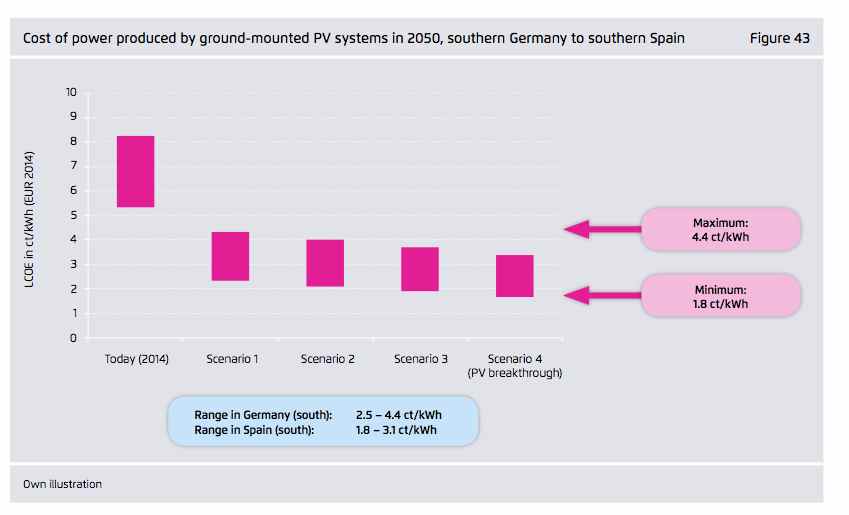
A major new study from a leading German think tank and renewable energy specialist says the cost reduction potential of large scale solar is still misunderstood, and predicts that solar PV will be the cheapest form of power within a decade, and cost less than $US0.02/kWh by 2050.

The study by the Berlin-based Agora Energiewende says that the end to cost reductions from solar plants is “not in sight”, even after falling more than 80 per cent in recent years.

It cites a range or reasons for this. Primarily, though, it comes down to an expected doubling in module efficiency, which will mean less panels are needed to produce the same amount of power, and therefore less land, less materials, less maintenance and lower installation costs.

These balance of systems costs are expected to fall by up to 2/3 in coming decades, and combined with a fall in the cost of finance, could cut the cost of solar technology in areas such as Australia, the US and parts of Europe to as low as 1.5 Euro cents/kWh.

“Even in the most conservative scenarios for market development, without considering technology breakthroughs, significant further cost reductions are expected,” the report says.
The forecasts produce a range of outcomes, depending on the actual increase in module efficiency – to 24, 30, or 35 per cent; the scale of deployment in coming decades, and the extent of “learning rates”.

Finally, depending on annual sunshine, power costs of Euro 4-6 c/kWh are expected in Europe by 2025, reaching Euro 2-4 c/kWh by 2050. That means it will be cheaper than conventional technologies – which costs between Euro 5c and 10c/kWh – by 2025.
It will even cheaper – at Euro 1.5c/kWh in countries with more sun.

“For the next decade, this represents a cost reduction of roughly one third below the 2015 level,” it says. “In the long term, a reduction of roughly two thirds compared to the current cost is expected.”
Lead author Daniel Fuerstenwerth said one of the reasons for the study was the lack of recognition among policy makers and advisors about future cost falls in solar PV, and official forecasts which continued to downplay the potential role of the technology.

This is despite the fact that organisations such as the International Energy Agency has predicted that solar costs would fall to 4c/kWh, and would in effect become “unstoppable”, and predicts it will be biggest single source of energy by 2050. Even Australia’s Bureau of Resource and Energy Economics recognises that solar will be the cheapest technology by 2030.

“The long term scenarios tend to underestimate the role of solar in power systems and in decarbonisation efforts,” Fuerstenwerth told RenewEconomy in a phone interview.

“When you look at the scenarios being prepared – there is always a very small share of solar. For example, in Germany, the power grid system is being discussed for scenarios that include a maximum 10 per cent share of solar PV in long term future.”

The Agora study found that in “large parts” of Europe, large scale solar was likely to be competing with conventional technologies – which costs between Euro 5c and 10c/kWh – by 2025.


agora cost ground mounted


In other regions of the world with higher solar irradiation, solar power will be even cheaper than in Europe.

“Our results indicate that solar power will become the cheapest source of electricity in many regions of the world, reaching costs of between Euro 1.6 and 3.7c/kWh in India and the Mena region (Middle East and North Africa) by 2050.

Cost competitive- ness with large- scale conventional power plants will be reached in these regions already within the next decade, at a cost for solar power by 2025 ranging between 3.3 and 5.4 ct/kWh.

(Indeed, in UAE for instance, solar is already cost competitive, with a tender for 200MW of solar going at less than $US0.06/kWh, less than the prevailing cost of gas-fired generation at $US0.09/kwh.

In North America, the study predicts that costs for large scale solar photovoltaics will reach Euro 3.2 to 8.3c/kWh in 2025 and Euro 1.5 to 5.8 c/kWh in 2050, the wide cost range due to significant geographical differences within the region.

In Australia, the study says, costs will reach Euro 3.4 to 7.1c/kWh in 2025 and 1.6 to 4.9 c/kWh in 2050. Interestingly, the study underlines how the cost of capital will be critical to the cost of electricity delivered by solar. This graph below illustrates how (remember the currency is in Euro).


agora cost country

“The cost of capital is and will remain a major driver for the cost of power from solar photovoltaics,” the report says. “Producing power from solar photovoltaics requires a high up-front investment, but subsequently allows power production for 25 years and more at a marginal cost of close to zero. It is thus a very capital-intensive power-generation technology, and the interest paid on both debt and equity has a large effect on the total cost of a large-scale photovoltaic project.”

It estimates the difference of the cost of technology could be as much as 50 per cent. “The regulatory environment will thus be key for reducing the cost of power from solar photovoltaics in the future, as the cost of capital is largely driven by the risk perceived by investors,” it notes. Australian developers understand this very well.

Here is the estimates on all regions:

agora solar


RenewEconomy Free Daily Newsletter


Saturday, February 14, 2015

The Hockey Stick and the Climate Wars


 Michael E. Mann is one of the world's leading atmospheric scientists.  He was a principle researcher in the process of creating a record of atmospheric temperature trends over the past millennia.  Using ice core samples and tree growth ring data, he and his colleagues were able to demonstrate that the last hundred years have been the warmest in well over a millennia.  The paleoclimatological record Mann and his colleagues were able to develop has been peer reviewed and confirmed by dozens of other climate scientists. Other scientists, employing alternate research pathways, have developed data sets that affirm the conclusion drawn by Mann and his colleagues. Global climate change linked directly to elevated levels of carbon dioxide and other greenhouse pollutants in the atmosphere has caused a substantial and measurable increase in average, leading to sea level rise, and more extreme weather, including draughts, flooding, wildfires, and more powerful hurricanes and tornados.

Our human addiction to fossil fuel energy like oil and coal is the primary cause of global warming.  That is the conclusion of  Intergovernmental Panel on Climate Change, an institution put together by the world's governments.  The science behind this conclusion has been proven beyond any doubt. It is
undeniable.

Well actually, if you are in the business of mining coal or pumping oil, survival depends on denial.  Oil is the most profitable business in the history of the world. The barons in charge of big oil, coal, and natural gas, faced the prospect of having their industries and profits killed by what should be an inevitable transition to clean, inexhaustible alternatives to dirty fossil fuels. 

With survival at stake, big fossil energy interests have been spending hundreds of millions of dollars on disinformation campaigns, whose aim is to obfuscate and  deny any link between the burning of coal and oil and the pollution that drives climate change.


The Hockey Stick and the Climate Wars, written by atmospheric scientist, Michael E. Mann, chronicles the way his research has been attacked by deniers, pretty much all of whom are being paid by big fossil energy.


The same hired guns and the same nefarious tactics that were employed by big tobacco to deny the link between cigarettes and cancer, are now focused on confusing the public about climate change and the link to our use of coal and oil. What this amounts to is putting the future of human civilization at substantial risk in order to protect the profitability of big coal and oil.

The story of Representative Joe Barton, (R-Tx), Chair of the Congressional Science and Technology Committee,  is particularly sordid. .  Barton, who gets massive amounts of campaign money from the fossil fuel industry, is an ardent climate denier. He has long  used his powerful position to undermine the overwhelming scientific record that links dirty fuels to climate change. The best words to describe Barton and others in the Congress that deny climate science are shameful, corrupt and contemptible.

The Hockey Stick and the Climate Wars offers an unimpeachable analysis of all that's wrong with American public policy where energy is concerned.  The book is well written and thoroughly researched. I recommend it to anyone who wants to understand why we are still fighting this battle.  Coal, oil, and natural gas are old news. There are plenty of clean energy options emerging. Many are already cost competitive with fossil fuels. The transition away from dirty energy is already underway.

Dishonest denial in support of coal and oil profit must not be allowed to obstruct the move to clean sources of energy for even a moment longer.


Friday, January 30, 2015

Japan Bets Big on Hydrogen Power


I read a report today that Japan will invest $385,000,000 on building a network of Hydrogen fueling stations across the nation. That should provide for enough fueling stations to pretty much cover all of Japan, plus all the support infrastructure required.  I would call that a major league commitment to hydrogen as a clean, inexhaustible transportation fuel. It's no surprise that Japan has choosen to lead the world on hydrogen. Toyota and Honda have major commitments to hydrogen fuel cell cars. 

Europe has also committed millions of Euros to the construction of hydrogen fueling stations across the continent.

Where does that leave us in North America? The short answer is behind...a long way behind. In the US and Canada, energy policy is still controlled by the fossil energy industry. They own the Congress on this issue. The same is true in Canada, where the conservative government is focused on smoothing the path for the Keystone XL pipeline, that will carry dirty Canadian tar sands oil down through the US to ports in the American south. From there,  mega-tankers loaded with crude depart across the seas.to the rest of the world. 

It's true, the price of gasoline has dropped substantially in recent months due to a glut of oil in the world market.  Cheap gas is certainly easy on the wallet, but current low prices are just a temporary reprieve. Beyond the economics, we humans have an obligation to future generations to disconnect ourselves from dirty fuels. That is the only answer to the overriding global problem of pollution driven atmospheric warming. 

Hydrogen as a fuel option is not a panacea, but  it is a very important part of a cost effective,  clean energy mosaic that can and ultimately will make coal, oil, and natural gas old news.   Bravo to Japan for leading the way on hydrogen infrastructure development.


Tuesday, January 27, 2015

Michio Kaku on Hydrogen Power


At the 2015 Consumer Electronics Shown in Las Vegas, Michio Kaku, Physicist, author, and well TV science  personality, introduced Toyota's newest fuel cell powered car. The fuel it uses is hydrogen, the most abundant element in the universe. Hydrogen is inexhaustible in supply, non-toxic, and pollution free. When used to power a car, the only exhaust byproduct is water.

I started making videos about renewable energy and hydrogen in the early nineties.  For the last decade,  all of the clean energy thunder has been sucked by a range of battery technologies. There is definitely an important place in our energy future for batteries, but they are not a panacea. 

In 2015, Toyota, Honda, and Hyundai will have production fuel cell cars available in showrooms in California.  The big limiting factor on these vehicles is the lack of a fueling infrastructure.  In the US, only Southern California currently has hydrogen available at public fueling stations.  Let's hope the political will with our elected officials is there to rapidly expand the hydrogen fueling infrastructure across the nation. 

I wrote a book called The Hydrogen Age was published in 2007. It is gratifying to see the kind of future I wrote about in that book coming to pass.

Here is Michio Kaku introducing Toyota's first production fuel cell car. https://www.youtube.com/watch?v=puvy6QxlPso


Tuesday, January 20, 2015

The Nature of Sustainability


Over the years, I have tried to be a student of good planetary stewardship.  The ultimate prize is a humanity that functions in harmony with nature. This is what comes when what we take from the biosphere balances out with what we give back to it.  

In the U.S. and in other economically advantaged countries, People mostly take for granted their supply of fresh water, the ready availability of inexpensive food, cheap energy to heat our homes and power our transport options, and esthetically pleasing and healthy living environments.  Up until recently, we have also been accustomed to living with minimal risk of extreme, destructive weather.

These days, the natural systems and resources that we count on for stability in our lives are rapidly disappearing.  If the Earth was a bank with a fixed amount of equity assets, healthy living would equate to getting along on just the interest generated by that equity. In fact, our consumption goes way beyond that. We are drawing deeply into the Earth’s resource equity, and putting economic stability and our lives at ever greater risk because of it.   

It doesn’t have to be that way. We can live in balance with our planet’s ability to provide. We can, but it requires making some hard and some not-so-hard choices on a local, national, and a civilization scale.   

We are using up our fresh water. We are sucking the life out of our oceans. We are stripping our living landscapes bare. We are on a truly reckless path with the only home we have.

Energy is a very big sore spot on Planet Earth. The human consumption of fossil hydrocarbons like coal and oil has put our atmosphere in a perilous state.  Climate change is driven by human lifestyle habits; not just the burning of dirty forms of energy, but also our ever expanding appetite for animal flesh.  These days, the sun, and the wind are inexhaustible in supply.  Moreover, both small and massive scale technologies are now available to convert these clean and natural forms of energy into heat and electricity at costs that are competitive or even cheaper than the dirty energy we’ve depended on since the beginnings of the industrial age.   

There is also a personal lifestyle decision that could dramatically reduce the 80 million tons of methane produced annually by the livestock animals we consume.  The answer is simple:  eat less beef, pork, and poultry. The less, the better.   Keep in mind that methane is twenty times more potent as a greenhouse pollutant than carbon dioxide.  Even a small cut in a person’s animal protein consumption, if widely adopted, could really make a difference. It’s an easy and also a healthy way to move to the right side of history.

Sooner or later, humans will get to the right side of history. We will learn to live in harmony with nature. We  have the technology to take us there.  This much is clear: the longer we put off a transition to a life-affirming path, the bigger the mess we leave for future generations.

If we are going to build a future worthy of our species, a sustainable future, living in harmony with the gifts of nature, we the people must step up and be the change we wish for.    


Saturday, November 29, 2014

Thinking About a New Car


We currently have. one car,  a 2006 Honda Civic sedan. We bought it because the mileage rating was 32 city/40 highway. That was pretty much as good as it got at that time, except for  the Toyota Prius, which cost a lot more (at that time) and did not get that many more miles per gallon.

We've had our Civic for nine years. In that time, it has performed almost  flawlessly, and remains in very good condition. We could probably do very nicely with it for another ten years. There's just one problem. It uses gasoline.

We are now thinking about getting another car, one that reflects our commitment to ending our dependence on oil. The good news is there are many more options for electric cars, hybrids, and plug in hybrids than ever before. In the next few years, plug-in hybrids will emerge much more as an important clean energy alternative to the cars we are accustomed to filling up weekly with gasoline.

The good news is, the price of gasoline is dropping because the demand is dropping. A lot of the gas we use these days comes from Canadian tar sands and the Bakken shale fields in North Dakota. This kind of gasoline is costly to recover, so shrinking gas prices are making that kind of oil less profitable than the big energy companies would like.

To me, that is good news. If we citizens keep buying cars that use less, or in some cases, no gasoline, demand drops, the price at the pumps drops. Pretty soon, we could get a situation where the best thing to do with oil deposits is to leave them in the ground.  That's would be a very good place to be.

My wife and I would like to get a new car. We would like to have an SUV .  That means a bigger vehicle that costs more.  The perfect choice for us would be a plug in hybrid SUV,  that would run on electricity for about 85% of the driving we do.  Unfortunately, there are no SUV options like that at the moment, so we will stick with our 2006 Honda sedan until the right option comes into the marketplace.  I expect that to happen in the next year or two.

If I thought we could get by with the limited range of an electric car, we would have to look seriously at some of the sedan options that are out there now, including the BMWi3, the Honda FIT  EV, the Nissan Leaf,. I also like the Chevy Volt. If they made an SUV version of the Volt, I would buy it today.

I want to make a statement with my choice of a pollution free car. I want to be the example that encourages others to wean themselves from dirty energy.  

For sure, I will never buy another car that runs only on gasoline. That's my commitment. I urge everyone to do the same.  You want to do something about climate change, it can start with your personal decision when buying a car.


Thursday, November 20, 2014

Our Home in 4K Video


Here we have a marvelous, high definition video of the Earth from space over four cycles of day and night. It was taken in May, 2011 by the  geosynchronous Electro-L weather  satellite.

I find myself in awe. The real Earth, the place we live, just seems so beautiful, so full of color, so alive.  It looks vibrant and alive. It doesn't look fragile, not at all... but what you can't see from 23,000 miles in space are the planet's 7.26 billion human residents. What you can't see are the relentless demands we humans put on the Earth's finite fresh water, forest, and  living ocean resources.  What you can't see is just how badly we humans have shredded the planet's living fabric.


When I look at this video, I want to nurture and protect this place. I want to stop people from abusing it.

This Earth is the only home we have...


Here is the link to a gorgeous view of planet Earth... https://www.youtube.com/watch?v=Ybh11kcDhfM#t=73


Saturday, November 1, 2014

Green World Rising


A new video produced by Leo DeCaprio and Thom Hartmann shows that with existing technology, our global human society can be completely free of our dependence on coal, oil, and natural gas in about two decades.

Clean, renewable sources of energy from wind, solar, geothermal, and hydro power derived from ocean tidal forces and river currents can provide all the power the world needs without generating any atmospheric pollution.  This new video, narrated by Leo DeCaprio presents that clean energy future very effectively. 

The impediments to this kind of life-affirming future are not technical. We can do it with technology that is already developed.  The obstacle to this kind of future is entirely political, driven by corporatists and elites who profit from the status quo and are unwilling to accept any change that threatens their income.

Bottom line: A clean energy future is imminently achievable, if the people demand it.

Here is a link to Green World Rising... http://www.greenworldrising.org/#!ep3-green-world-rising/ches


Wednesday, October 29, 2014

Elon Musk's Big Bet on Batteries


The advances in battery technology are very impressive.   It certainly appears that we are on the cusp of a transition away from dirty hydrocarbon fuels like oil to a world powered by clean, renewable sources of electricity like wind and solar. The sooner it happens, the better..

Ultimately,  battery electric cars will have a big place on our highways, but they will hardly be the only option. In fact, the plug in hybrid (PHEV) that combines an electric motor to power the wheels, batteries to store energy, and a small, on board fuel cell to recharge those batteries could turn out to be the best, long term solution for our all around transportation needs. Why? Because the solar panels on your house that can be used to recharge your car's batteries, can also be used to produce hydrogen, a clean, inexhaustible energy commodity that can  power a PHEV vehicle's on board fuel cell.   This technology is already nearing maturity. In a few years, fuel cells could be integrated into PHEV vehicles at a cost that's competitive with the gasoline engines we have relied on for a hundred  years.

Elon Musk is all about batteries. He is definitely pushing the technology envelope with his massive commitment to battery production.  We are now seeing credible predictions that a clean energy transition could be nearly complete by 2050.  That means, almost everything will run on wind and solar generated power.

More than anything at this point, we must find the political will to overcome the aggressive resistance already coming from obsolete technologies...  It can't happen too soon.


_________________________

Why Musk Is Building Batteries in the Desert When No One Is Buying


Tesla’s planned 5-million-square-foot ‘gigafactory’ wouldn’t just be the biggest battery factory in the world. It would be one of the biggest factories in the world, period. But hours before CEO Elon Musk took the podium last week to tout the $5 billion facility came August sales numbers for electric vehicles and a spate of news stories about how U.S. interest for electric cars has stalled.

So what gives? Why would Tesla build capacity for half a million car batteries a year if no one is buying? Four charts below tell the story.

First the bad news.


August brought another month of electric-car sales that came up short of previous highs. Interest isn’t falling, but at four percent market share for combined sales of hybrids and plug-ins, people aren’t exactly clamoring for them. The dark blue shows hybrids, the light blue shows anything with a plug; stack them together and you've got what's known as the electrified-vehicles market.

But here’s the thing: the “stall” is happening entirely in the category of plugless hybrid vehicles (shown above in darker blue). These are gasoline engines backed by fuel-saving battery drive systems. The batteries are primarily nickel-metal hydride like those found in the standard Toyota Prius -- not the high-efficiency lithium ion batteries that Elon Musk wants to crush the market with.

Here’s what’s happening in the smaller subset of cars that don’t require liquid fuel to roll:

Time to plug in.


The chart above shows the exponential rise of U.S. plug-ins. The light purple signifies rising monthly sales, while the dark purple shows cumulative sales since December 2010.

The rise of the plug-in has been fast, but the category is still diminutive. Most car trackers put plug-in sales at a fraction of a percent of U.S. vehicles sales. But just as it’s misleading to lump in growth with hybrid gas cars, comparing plug-ins to all vehicles on the road isn’t apples to apples. Plug-in SUVs are only just starting to hit the market.

The chart below shows plug-ins as a share of U.S. car sales, excluding those larger vehicles.


Quiet, but with great acceleration.


For 2014, plug-ins average 1.5 percent of cars sold in the U.S. That’s still not a lot, and the trendline for market share appears more incremental than exponential. At this rate, plug power wouldn’t be the dominant form of fuel until the end of the century.

And that excludes the ever-popular SUV category. The BMW i3 and the Mercedes-Benz B Class are still rolling out. Tesla and Toyota recently ended their collaboration on a $50,000 plug-in version of a RAV4 after just 2,000 units sold in two years. Like the Nissan Leaf, the RAV4 was hampered by a limited battery range: 100 miles. Musk told reporters in Tokyo last week that he envisioned a larger project with Toyota than the RAV4 “maybe two or three years from now.”

Tesla's first SUV, the Model X, is set to go on sale in the first half of next year, complete with a third row, space-age falcon doors (pictured above), all-wheel drive and little compromise on the Model S’s 265-mile range. Here’s a sneak peak of pre-orders for the Model X, based on self-reported waitlist numbers tracked on a Tesla Motors Club forum (Tesla doesn’t release pre-order tallies). A reservation for the luxury Model X requires a $5,000 deposit.

Americans heart SUVs.


These reservation numbers are significantly higher, and picking up faster, than reservations of the Model S prior to its June 2012 ship date.

Still, to justify the gigafactory, it would take additional market forces to bend the curve skyward on plug-in market share. That’s exactly what Tesla is working on. The biggest obstacles to plug-in adoption are availability of charging stations, range, charge time and cost. Here’s where those things stand:

Charging stations: By the end of the year, there will be more than 5,000 electric charging stations operating in the U.S., according to the U.S. Energy Department. In the first half of 2014, more stations were opened than from 1970 to 2011 combined.

Range: Drivers want to know they can make their daily commute, get stuck in unexpected traffic and stop by the store for some emergency pickles without having to worry about being stranded. The best-selling Nissan Leaf, at $30,000, leaves room for worry with its 84-mile average range. The high-end Tesla Model S, at more than twice the price, has an EPA-rated range of 265 miles. That’s a lot of pickle stops.

Charge time: Home charging of a Tesla is still a commitment at 58 miles per hour of charge. The Tesla Supercharger stations, on the other hand, get 170 miles in 30 minutes. Musk has opened up the system’s design for other carmakers to adopt.

Cost: Tesla hasn’t released the official price tag for the Model X, but it’s expected to be in the same luxury range as the Model S, which starts at $60,000 for a version with smaller battery. Bringing down the cost of batteries will be key to plans for a more-affordable Model 3, still years away from market. Musk estimates the gigafactory will reduce the cost of lithium-ion battery capacity by 30 percent.

Musk’s diamond factory.


Last week, Tesla released sketches of the future plant. It’s powered by renewable energy and shaped like a diamond. So why has Musk designed a gigafactory to produce batteries for half a million cars a year (twice the number that's been put on the road by all companies combined)? Because it's increasingly looking necessary.


Deutsche Bank analyst Rod Lache last month increased his estimate for sales of the Model S and Model X to 129,000 units in 2017, from a previously estimated 83,000. Tesla can reach its 500,000 annual run rate before the end of the decade, Lache said, in time to put the gigafactory to full use. 

Tesla’s growth will be “much steeper, their mix will be much richer, and their costs will ultimately be much lower than we previously assumed,” Lache wrote in a report on Aug. 11.

This doesn’t mean you should rush out and buy Tesla stock. Just 11 out of 20 analysts tracked by Bloomberg give the company a “buy” rating, and the stock price is 261 times estimated earnings, compared with a 12.5 estimated P/E for Ford Motor Co. Even Musk admitted last week that the stock price is “kind of high” right now.

Still, it’s easy to get caught up in Musk’s vision for the future of cars. Defying skeptics, Musk has established the biggest U.S. solar company by market value, built a private space company that’s making deliveries to the International Space Station, and has conjured a $35 billion car company out of thin air.

Now the dude’s got diamonds in his eyes.


Solar Energy Poised for Massive Expansion


So, the evidence of the obsolescence of coal, oil, and natural gas energy is emerging rapidly.  The article below just appeared in Bloomberg news.  The cost of solar has dropped so much, that it is about to become cheaper than coal, oil, or natural gas in nearly every U.S. state.  Very exciting news.

One caveat. U.S. energy policy is still controlled by the fossil energy giants.  They are not about to have their hydrocarbon reserves turned into stranded assets... not without a fight.  They are already waging an aggressive campaign to deny climate change and to undermine clean, renewable energy technologies like wind and solar. They will impede progress as long as they can.

At the end of the day, it will  be up  to American voters to elect politicians who will create a new nationwide energy policy that will allow us to fully realize a transition to clean, renewable, low cost energy. 


__________________________

While You Were Getting Worked Up Over Oil Prices, This Just Happened to Solar


Every time fossil fuels get cheaper, people lose interest in solar deployment. That may be about to change.

After years of struggling against cheap natural gas prices and variable subsidies, solar electricity is on track to be as cheap or cheaper than average electricity-bill prices in 47 U.S. states -- in 2016, according to a Deutsche Bank report published this week. That’s assuming the U.S. maintains its 30 percent tax credit on system costs, which is set to expire that same year.

Even if the tax credit drops to 10 percent, solar will soon reach price parity with conventional electricity in well over half the nation: 36 states. Gone are the days when solar panels were an exotic plaything of Earth-loving rich people. Solar is becoming mainstream, and prices will continue to drop as the technology improves and financing becomes more affordable, according to the report.


Grid Parity to Reach 36 States in 2016

Solar has already reached grid parity in 10 states that are responsible for 90 percent of U.S. solar electricity production. In those states alone, installed capacity growth will increase as much as sixfold over the next three to four years, Deutsche Bank analyst Vishal Shaw wrote in the Oct. 26 report.
The reason solar-power generation will increasingly dominate: it’s a technology, not a fuel. As such, efficiency increases and prices fall as time goes on. The price of Earth’s limited fossil fuels tends to go the other direction. Michael Park, an analyst at Sanford Bernstein, has a term for the staggering price relationship between solar and fossil fuels: the Terrordome. I’m not sure exactly what that means, but it doesn’t sound very forgiving.

 Solar will be the world’s biggest single source of energy by 2050, according to a recent estimate by the International Energy Agency. Currently, it’s responsible for just a fraction of one percent.
Because of solar's small market share today, no matter how quickly capacity expands, it won’t have much immediate impact on the price of other forms of energy. But soon, for the first time, the reverse may also be true: Gas and coal prices will lose their sway over the solar industry


Thursday, June 26, 2014

Hope on Earth


Hope on Earth, is a highly engaging dialogue between two  remarkable human beings,  Stanford Professor Paul Ehrlich, President of Stanford’s Center for Conservation Biology,  and global ecologist/author/anthropologist/filmmaker Michael Tobias.   Ehrlich is best known for The Population Bomb, a book co-written with his wife Anne more than four decades ago.  I should mention that I was a young man when I read the Ehrlich’s book back when it first came out.  Chilling as its message was, then and now, that book had a profound impact on my understanding of the world.  Dr. Tobias’ work is also well known to me. He is the author of more than fifty books, including World War III – Population and the Biosphere at the End of the Millennium and, with his colleague, partner, and wife, Jane Gray Morrison,  Sanctuary – Global Oasis of Innocence. Tobias has also had a distinguished career as a film maker – more than 150 productions - on subjects (mostly non-fiction, but some fiction) related to animal rights’, biodiversity, and humanity’s tenuous relationship with the environment.  Tobias is also the long-time President of The Dancing Star Foundation, a global animal protection, biodiversity conservation, and environmental education non-profit.


Both men have spent much of  their lives investigating and reporting on the massively expanded pressure on our biosphere caused by human population growth.  To put this in perspective, the number of people on Earth when The Population Bomb was first published in 1968 was 3.5 billion. In all of human history, it took till then to get to 3.5 billion. In the 46 years since that time, the population has more than doubled to 7.25 billion. This massive human expansion is not sustainable. The Earth’s resources are finite. We humans are pushing our freshwater, our farmland, our forests, our marine resources rapidly  to exhaustion. Our dependence on fossil fuels like oil and coal is pumping billions of tons of pollutants into the Earth’s atmosphere, causing a planetary warming that puts the very livability of our tiny dot in the galaxy at great risk. Human exploitation is pushing unprecedented numbers of plant and animal species to the point of extinction.  In fact, the consensus seems to be, for humanity to live within the planet’s long term ability to provide sustenance for most sentient beings, including Homo Sapiens,  the human population should no more than about one to two billion.  The current condition for humanity is one of extreme overreach.  Can we turn it around? Can we change our ways sufficiently to roll back  human demand so it does not exceed the planet’s ability to provide?   

Ehrlich and Tobias are skeptical. Despite that, they remain hopeful. They have both  been aggressively sounding a warning for decades. They both clearly detest the general state of public indifference, and even hostility in some cases,  despite the powerful warning signals we are getting from nature; signals like the melting of our glaciers and the collapse of the polar icecaps, the increasing incidents of extreme draught, wildfire, floods, and massive and highly destructive weather events like Hurricane Sandy and Super Typhoon Haiyan. 

In Hope on Earth, Ehrlich warns, “The past is over. We’re here now, and we’d better damn well make our ethical decisions.”  He goes on to say, “If we don’t solve the issues of population growth and consumption, all the rest of these issues won’t stand a chance of being remedied.”

Ehrlich and Tobias agree that humanity must find a path to achieving critical mass in awareness, and beyond that, a thoughtful, ethical approach to the unprecedented global-scale challenges that have emerged. The course we are on is a dead end.

I really enjoyed reading Hope on Earth. In the end, it is a dialogue about ethics. I loved being a fly on the wall, absorbing this great conversation between two exceptional minds, who understand and care deeply about the ugly turn human history has taken. Their prescription: Wake up and embrace a life-affirming cultural paradigm built on a foundation of compassion, and commitment to planetary stewardship. Do it now, before it is too late.

I give five stars to Hope on Earth. Highest recommendation.
__________________________