Showing posts with label Clean Tech. Show all posts

Saturday, March 7, 2015

My Visit to Solarworld


Solarworld, one of the world’s leading producers of commercial and residential solar PV panels is located just a few miles west on Highway 26 in Hillsboro. The business of producing solar panels that generate electricity is booming.   There are several reasons the solar PV business is so good these days. The biggest factor is the urgent need to end our dependence on coal and oil for energy. Our addiction to dirty fossil fuels has put us on a collision course with climate change.  Weather extremes driven by human induced atmospheric warming are already here. Anybody noticed how warm it’s been in the first few months of 2015 in Oregon? What happened to the endless rain we normally experience in the winter months?  The short answer is elevated sea surface temperatures caused by human induced atmospheric heating. 

The other factor favoring wind and solar PV is the amazing drop in cost.  Solar and wind are already economically competitive to the long entrenched, dirty forms of energy on which we have long been dependent.  Nobody is investing in new coal, oil, or nuclear infrastructure these days, because it just doesn’t make financial sense.  

Kevin Keene, Regional Sales Manager for Solarworld, gave me a tour of the company’s plant in Hillsboro, Oregon, a few miles from my home.

Solarworld Plant, Hillsboro, Oregon
 
 
Solarworld manufactures photovoltaic panels that are made up of silicon-based PV wafers linked together in 38” X 66” sealed panels. The panels are 17% percent efficient at converting solar photons from the sun into electricity. Each panel is able to generate about 280 watts of electric power. In commercial and residential applications, the panels are coupled together to achieve the power level desired. A typical rooftop residential system would link 12 panels to deliver about 3500 kWh of energy, enough to meet at least half of a typical American home’s energy needs.

Kevin from Solarworld showed me the Hillsboro plant’s main manufacturing facility.  We took an elevator to the second floor and found ourselves in an open office that spans the length of the plant, with large windows overlooking the production line.


It’s no wonder the cost of PV panels is dropping precipitously. The entire production process is automated, with robots handling virtually every task.  The cavernous production space is filled with machines linked by conveyors that move each unit from one assembly step to the next. I only saw a handful of people working in the assembly area. Most of them were inspectors, tasked with conducting a rigorous round of testing to confirm that each panel produced meets Solarworld’s very high standards.

The assembly line operates 24 hours a day, with only a fraction of a percent of the new PV panels rejected because of defects or substandard performance.  Solarworld’s current production line, operating at maximum output, puts out 360 Mw annually.   The company is adding a new production line in an adjacent building that will increase capacity by nearly 50 percent. 

The clean energy revolution is clearly underway, and Solarworld is a big part of it. Their technology is second to none in quality and performance, and very competitive in cost.  

I don’t have any financial incentive or otherwise to endorse Solarworld. I just think it’s a very good company, with great technology, with a business model that works in the new, clean energy marketplace.  I expect to have solar PV on my roof in the near future. Very likely the panels will be made by Solarworld,  a ‘Made in America’ success story.

Check out this video…

Here is the link to Solarworld’s webpage…  http://www.solarworld-usa.com/

Wednesday, February 25, 2015

Solar Energy - Too Cheap to Meter?


Commercial scale solar power is headed for 2 cents/kWh.  That kills the economic justification for pretty much any fossil fuel alternative, as well as nuclear.  If  we were not subject to the deep pockets political influence of the coal, oil, gas, and nuclear power interests,  we would likely already have a national energy policy that would fully encourage the transition to clean, inexhaustible energy alternatives like solar and wind.  Unfortunately, we are under the influence of a hulking, profit driven corporate juggernaut.  Their game is lame, but their money is buying them a  lot of time in the public policy driver's seat.  Their blind pursuit of profit is causing our Earth's natural systems to collapse.  We must change our ways. The sooner, the better.

Where energy is concerned the future is already emerging.

Every place on Earth has access to some type of clean, low cost energy. In transport applications where an energy source is needed that is both clean and available on demand, the path of least resistance is battery stored electricity. In many transport applications, battery stored electricity will not meet the load requirements.  That is where hydrogen comes in as an energy carrier. Hydrogen is the simplest, most abundant element in the universe.  It is clean, non-toxic, and inexhaustible in supply. You can't mine hydrogen, you have to make it by splitting it away from chemical bonds with readily available chemical compounds, like water.

The simplest way to make hydrogen is to split water molecules, which consist of two hydrogen atoms linked to an oxygen atom.   In an electrolyzer, it  takes about 50 kWh of electricity to split about   two gallons of water into enough free hydrogen to equal the energy in one gallon of gasoline.  At 2 cents/ kWh, you would need about a dollar's worth of the solar energy to make the hydrogen equivalent of gasoline. When run through a fuel cell, the efficiency of energy delivered to the wheels of a car from hydrogen is two or three times better than gasoline IC engine. 

I recently got a bid to put a 5,000 kWh solar PV system on the roof of my house. After government incentives, the system would pay for itself in about three years. After that,  all the electric power it produces would be pretty much free. Surplus electricity generated by such a system could be routed through a small residential scale electrolyzer to produce hydrogen for use on demand.  The stored hydrogen could be used to power the home at night when the solar panels are not producing. It could also be used in a car powered by a fuel cell.  Some see hydrogen as a competitor for battery technology. A lot of trash talk still emanates from some battery enthusiasts.  I share the opinion of many people who have a stake in the success of hydrogen.  The fact is hydrogen is an inexpensive way to store electricity for use later on demand. Hydrogen and electricity are two sides of the same coin. They complement each other beautifully. It just makes sense for  them to coexist.


The problem we have now is that our government's energy policy has been captured entirely by big oil, coal, and nuclear interests.  They own the majority of our elected politicians, and those politicians are aggressively engaged in obstructing the pathway to a clean energy future.  Because of that brand of political intransigence, the US is dragging its feet on the clean energy revolution, Instead, it is Europe, Japan, and China that are leading the way. 

I want to live in a  net zero energy house, and I want to drive a car that is pollution free and running on a fuel I can generate with the solar panels on my roof.  A growing number  of  people are already on that pathway.  In two years, I expect to be part of that caravan.

The attached article comes from the renew economy website


____________

Solar at 2c/kWh – the cheapest source of electricity

By Giles Parkinson

Major new study says policy makers and energy planners still underestimating cost potential of large scale solar. It says that within in a decade, it will be cheapest form of power and will fall to 2c/kWh.

agora solar cost fall


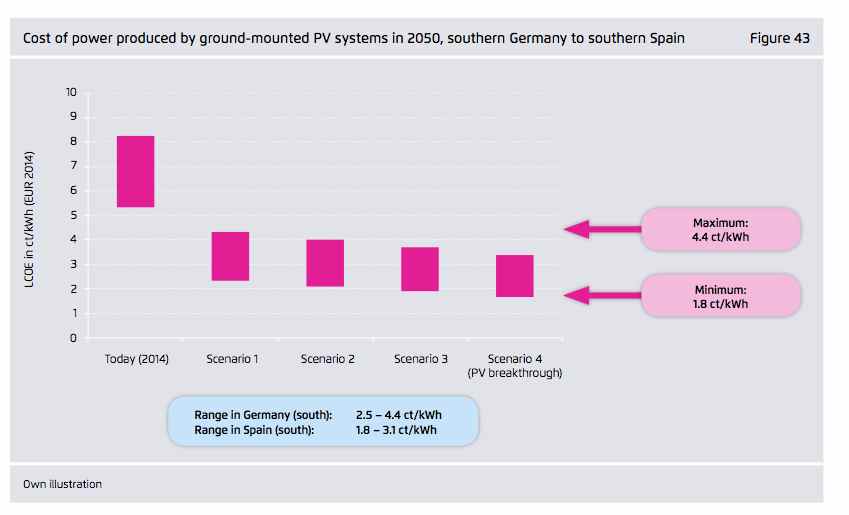
A major new study from a leading German think tank and renewable energy specialist says the cost reduction potential of large scale solar is still misunderstood, and predicts that solar PV will be the cheapest form of power within a decade, and cost less than $US0.02/kWh by 2050.

The study by the Berlin-based Agora Energiewende says that the end to cost reductions from solar plants is “not in sight”, even after falling more than 80 per cent in recent years.

It cites a range or reasons for this. Primarily, though, it comes down to an expected doubling in module efficiency, which will mean less panels are needed to produce the same amount of power, and therefore less land, less materials, less maintenance and lower installation costs.

These balance of systems costs are expected to fall by up to 2/3 in coming decades, and combined with a fall in the cost of finance, could cut the cost of solar technology in areas such as Australia, the US and parts of Europe to as low as 1.5 Euro cents/kWh.

“Even in the most conservative scenarios for market development, without considering technology breakthroughs, significant further cost reductions are expected,” the report says.
The forecasts produce a range of outcomes, depending on the actual increase in module efficiency – to 24, 30, or 35 per cent; the scale of deployment in coming decades, and the extent of “learning rates”.

Finally, depending on annual sunshine, power costs of Euro 4-6 c/kWh are expected in Europe by 2025, reaching Euro 2-4 c/kWh by 2050. That means it will be cheaper than conventional technologies – which costs between Euro 5c and 10c/kWh – by 2025.
It will even cheaper – at Euro 1.5c/kWh in countries with more sun.

“For the next decade, this represents a cost reduction of roughly one third below the 2015 level,” it says. “In the long term, a reduction of roughly two thirds compared to the current cost is expected.”
Lead author Daniel Fuerstenwerth said one of the reasons for the study was the lack of recognition among policy makers and advisors about future cost falls in solar PV, and official forecasts which continued to downplay the potential role of the technology.

This is despite the fact that organisations such as the International Energy Agency has predicted that solar costs would fall to 4c/kWh, and would in effect become “unstoppable”, and predicts it will be biggest single source of energy by 2050. Even Australia’s Bureau of Resource and Energy Economics recognises that solar will be the cheapest technology by 2030.

“The long term scenarios tend to underestimate the role of solar in power systems and in decarbonisation efforts,” Fuerstenwerth told RenewEconomy in a phone interview.

“When you look at the scenarios being prepared – there is always a very small share of solar. For example, in Germany, the power grid system is being discussed for scenarios that include a maximum 10 per cent share of solar PV in long term future.”

The Agora study found that in “large parts” of Europe, large scale solar was likely to be competing with conventional technologies – which costs between Euro 5c and 10c/kWh – by 2025.


agora cost ground mounted


In other regions of the world with higher solar irradiation, solar power will be even cheaper than in Europe.

“Our results indicate that solar power will become the cheapest source of electricity in many regions of the world, reaching costs of between Euro 1.6 and 3.7c/kWh in India and the Mena region (Middle East and North Africa) by 2050.

Cost competitive- ness with large- scale conventional power plants will be reached in these regions already within the next decade, at a cost for solar power by 2025 ranging between 3.3 and 5.4 ct/kWh.

(Indeed, in UAE for instance, solar is already cost competitive, with a tender for 200MW of solar going at less than $US0.06/kWh, less than the prevailing cost of gas-fired generation at $US0.09/kwh.

In North America, the study predicts that costs for large scale solar photovoltaics will reach Euro 3.2 to 8.3c/kWh in 2025 and Euro 1.5 to 5.8 c/kWh in 2050, the wide cost range due to significant geographical differences within the region.

In Australia, the study says, costs will reach Euro 3.4 to 7.1c/kWh in 2025 and 1.6 to 4.9 c/kWh in 2050. Interestingly, the study underlines how the cost of capital will be critical to the cost of electricity delivered by solar. This graph below illustrates how (remember the currency is in Euro).


agora cost country

“The cost of capital is and will remain a major driver for the cost of power from solar photovoltaics,” the report says. “Producing power from solar photovoltaics requires a high up-front investment, but subsequently allows power production for 25 years and more at a marginal cost of close to zero. It is thus a very capital-intensive power-generation technology, and the interest paid on both debt and equity has a large effect on the total cost of a large-scale photovoltaic project.”

It estimates the difference of the cost of technology could be as much as 50 per cent. “The regulatory environment will thus be key for reducing the cost of power from solar photovoltaics in the future, as the cost of capital is largely driven by the risk perceived by investors,” it notes. Australian developers understand this very well.

Here is the estimates on all regions:

agora solar


RenewEconomy Free Daily Newsletter


Saturday, February 14, 2015

The Hockey Stick and the Climate Wars


 Michael E. Mann is one of the world's leading atmospheric scientists.  He was a principle researcher in the process of creating a record of atmospheric temperature trends over the past millennia.  Using ice core samples and tree growth ring data, he and his colleagues were able to demonstrate that the last hundred years have been the warmest in well over a millennia.  The paleoclimatological record Mann and his colleagues were able to develop has been peer reviewed and confirmed by dozens of other climate scientists. Other scientists, employing alternate research pathways, have developed data sets that affirm the conclusion drawn by Mann and his colleagues. Global climate change linked directly to elevated levels of carbon dioxide and other greenhouse pollutants in the atmosphere has caused a substantial and measurable increase in average, leading to sea level rise, and more extreme weather, including draughts, flooding, wildfires, and more powerful hurricanes and tornados.

Our human addiction to fossil fuel energy like oil and coal is the primary cause of global warming.  That is the conclusion of  Intergovernmental Panel on Climate Change, an institution put together by the world's governments.  The science behind this conclusion has been proven beyond any doubt. It is
undeniable.

Well actually, if you are in the business of mining coal or pumping oil, survival depends on denial.  Oil is the most profitable business in the history of the world. The barons in charge of big oil, coal, and natural gas, faced the prospect of having their industries and profits killed by what should be an inevitable transition to clean, inexhaustible alternatives to dirty fossil fuels. 

With survival at stake, big fossil energy interests have been spending hundreds of millions of dollars on disinformation campaigns, whose aim is to obfuscate and  deny any link between the burning of coal and oil and the pollution that drives climate change.


The Hockey Stick and the Climate Wars, written by atmospheric scientist, Michael E. Mann, chronicles the way his research has been attacked by deniers, pretty much all of whom are being paid by big fossil energy.


The same hired guns and the same nefarious tactics that were employed by big tobacco to deny the link between cigarettes and cancer, are now focused on confusing the public about climate change and the link to our use of coal and oil. What this amounts to is putting the future of human civilization at substantial risk in order to protect the profitability of big coal and oil.

The story of Representative Joe Barton, (R-Tx), Chair of the Congressional Science and Technology Committee,  is particularly sordid. .  Barton, who gets massive amounts of campaign money from the fossil fuel industry, is an ardent climate denier. He has long  used his powerful position to undermine the overwhelming scientific record that links dirty fuels to climate change. The best words to describe Barton and others in the Congress that deny climate science are shameful, corrupt and contemptible.

The Hockey Stick and the Climate Wars offers an unimpeachable analysis of all that's wrong with American public policy where energy is concerned.  The book is well written and thoroughly researched. I recommend it to anyone who wants to understand why we are still fighting this battle.  Coal, oil, and natural gas are old news. There are plenty of clean energy options emerging. Many are already cost competitive with fossil fuels. The transition away from dirty energy is already underway.

Dishonest denial in support of coal and oil profit must not be allowed to obstruct the move to clean sources of energy for even a moment longer.


Friday, January 30, 2015

Japan Bets Big on Hydrogen Power


I read a report today that Japan will invest $385,000,000 on building a network of Hydrogen fueling stations across the nation. That should provide for enough fueling stations to pretty much cover all of Japan, plus all the support infrastructure required.  I would call that a major league commitment to hydrogen as a clean, inexhaustible transportation fuel. It's no surprise that Japan has choosen to lead the world on hydrogen. Toyota and Honda have major commitments to hydrogen fuel cell cars. 

Europe has also committed millions of Euros to the construction of hydrogen fueling stations across the continent.

Where does that leave us in North America? The short answer is behind...a long way behind. In the US and Canada, energy policy is still controlled by the fossil energy industry. They own the Congress on this issue. The same is true in Canada, where the conservative government is focused on smoothing the path for the Keystone XL pipeline, that will carry dirty Canadian tar sands oil down through the US to ports in the American south. From there,  mega-tankers loaded with crude depart across the seas.to the rest of the world. 

It's true, the price of gasoline has dropped substantially in recent months due to a glut of oil in the world market.  Cheap gas is certainly easy on the wallet, but current low prices are just a temporary reprieve. Beyond the economics, we humans have an obligation to future generations to disconnect ourselves from dirty fuels. That is the only answer to the overriding global problem of pollution driven atmospheric warming. 

Hydrogen as a fuel option is not a panacea, but  it is a very important part of a cost effective,  clean energy mosaic that can and ultimately will make coal, oil, and natural gas old news.   Bravo to Japan for leading the way on hydrogen infrastructure development.


Tuesday, January 27, 2015

Michio Kaku on Hydrogen Power


At the 2015 Consumer Electronics Shown in Las Vegas, Michio Kaku, Physicist, author, and well TV science  personality, introduced Toyota's newest fuel cell powered car. The fuel it uses is hydrogen, the most abundant element in the universe. Hydrogen is inexhaustible in supply, non-toxic, and pollution free. When used to power a car, the only exhaust byproduct is water.

I started making videos about renewable energy and hydrogen in the early nineties.  For the last decade,  all of the clean energy thunder has been sucked by a range of battery technologies. There is definitely an important place in our energy future for batteries, but they are not a panacea. 

In 2015, Toyota, Honda, and Hyundai will have production fuel cell cars available in showrooms in California.  The big limiting factor on these vehicles is the lack of a fueling infrastructure.  In the US, only Southern California currently has hydrogen available at public fueling stations.  Let's hope the political will with our elected officials is there to rapidly expand the hydrogen fueling infrastructure across the nation. 

I wrote a book called The Hydrogen Age was published in 2007. It is gratifying to see the kind of future I wrote about in that book coming to pass.

Here is Michio Kaku introducing Toyota's first production fuel cell car. https://www.youtube.com/watch?v=puvy6QxlPso


Saturday, November 29, 2014

Thinking About a New Car


We currently have. one car,  a 2006 Honda Civic sedan. We bought it because the mileage rating was 32 city/40 highway. That was pretty much as good as it got at that time, except for  the Toyota Prius, which cost a lot more (at that time) and did not get that many more miles per gallon.

We've had our Civic for nine years. In that time, it has performed almost  flawlessly, and remains in very good condition. We could probably do very nicely with it for another ten years. There's just one problem. It uses gasoline.

We are now thinking about getting another car, one that reflects our commitment to ending our dependence on oil. The good news is there are many more options for electric cars, hybrids, and plug in hybrids than ever before. In the next few years, plug-in hybrids will emerge much more as an important clean energy alternative to the cars we are accustomed to filling up weekly with gasoline.

The good news is, the price of gasoline is dropping because the demand is dropping. A lot of the gas we use these days comes from Canadian tar sands and the Bakken shale fields in North Dakota. This kind of gasoline is costly to recover, so shrinking gas prices are making that kind of oil less profitable than the big energy companies would like.

To me, that is good news. If we citizens keep buying cars that use less, or in some cases, no gasoline, demand drops, the price at the pumps drops. Pretty soon, we could get a situation where the best thing to do with oil deposits is to leave them in the ground.  That's would be a very good place to be.

My wife and I would like to get a new car. We would like to have an SUV .  That means a bigger vehicle that costs more.  The perfect choice for us would be a plug in hybrid SUV,  that would run on electricity for about 85% of the driving we do.  Unfortunately, there are no SUV options like that at the moment, so we will stick with our 2006 Honda sedan until the right option comes into the marketplace.  I expect that to happen in the next year or two.

If I thought we could get by with the limited range of an electric car, we would have to look seriously at some of the sedan options that are out there now, including the BMWi3, the Honda FIT  EV, the Nissan Leaf,. I also like the Chevy Volt. If they made an SUV version of the Volt, I would buy it today.

I want to make a statement with my choice of a pollution free car. I want to be the example that encourages others to wean themselves from dirty energy.  

For sure, I will never buy another car that runs only on gasoline. That's my commitment. I urge everyone to do the same.  You want to do something about climate change, it can start with your personal decision when buying a car.


Saturday, November 1, 2014

Green World Rising


A new video produced by Leo DeCaprio and Thom Hartmann shows that with existing technology, our global human society can be completely free of our dependence on coal, oil, and natural gas in about two decades.

Clean, renewable sources of energy from wind, solar, geothermal, and hydro power derived from ocean tidal forces and river currents can provide all the power the world needs without generating any atmospheric pollution.  This new video, narrated by Leo DeCaprio presents that clean energy future very effectively. 

The impediments to this kind of life-affirming future are not technical. We can do it with technology that is already developed.  The obstacle to this kind of future is entirely political, driven by corporatists and elites who profit from the status quo and are unwilling to accept any change that threatens their income.

Bottom line: A clean energy future is imminently achievable, if the people demand it.

Here is a link to Green World Rising... http://www.greenworldrising.org/#!ep3-green-world-rising/ches


Thursday, October 30, 2014

Toyota's Hydrogen Inspiration


Just learned about this video from Michael Stitzki, an engineer from New Jersey, who has been on the leading edge of hydrogen energy technology for more than a decade.  I share Michael's belief that hydrogen is poised to become a major component of the clean, renewable energy era that is emerging. 

Here is the link to Toyota's very creative expression of confidence in hydrogen as an important, clean energy commodity. https://vimeo.com/106472439


Wednesday, October 29, 2014

Elon Musk's Big Bet on Batteries


The advances in battery technology are very impressive.   It certainly appears that we are on the cusp of a transition away from dirty hydrocarbon fuels like oil to a world powered by clean, renewable sources of electricity like wind and solar. The sooner it happens, the better..

Ultimately,  battery electric cars will have a big place on our highways, but they will hardly be the only option. In fact, the plug in hybrid (PHEV) that combines an electric motor to power the wheels, batteries to store energy, and a small, on board fuel cell to recharge those batteries could turn out to be the best, long term solution for our all around transportation needs. Why? Because the solar panels on your house that can be used to recharge your car's batteries, can also be used to produce hydrogen, a clean, inexhaustible energy commodity that can  power a PHEV vehicle's on board fuel cell.   This technology is already nearing maturity. In a few years, fuel cells could be integrated into PHEV vehicles at a cost that's competitive with the gasoline engines we have relied on for a hundred  years.

Elon Musk is all about batteries. He is definitely pushing the technology envelope with his massive commitment to battery production.  We are now seeing credible predictions that a clean energy transition could be nearly complete by 2050.  That means, almost everything will run on wind and solar generated power.

More than anything at this point, we must find the political will to overcome the aggressive resistance already coming from obsolete technologies...  It can't happen too soon.


_________________________

Why Musk Is Building Batteries in the Desert When No One Is Buying


Tesla’s planned 5-million-square-foot ‘gigafactory’ wouldn’t just be the biggest battery factory in the world. It would be one of the biggest factories in the world, period. But hours before CEO Elon Musk took the podium last week to tout the $5 billion facility came August sales numbers for electric vehicles and a spate of news stories about how U.S. interest for electric cars has stalled.

So what gives? Why would Tesla build capacity for half a million car batteries a year if no one is buying? Four charts below tell the story.

First the bad news.


August brought another month of electric-car sales that came up short of previous highs. Interest isn’t falling, but at four percent market share for combined sales of hybrids and plug-ins, people aren’t exactly clamoring for them. The dark blue shows hybrids, the light blue shows anything with a plug; stack them together and you've got what's known as the electrified-vehicles market.

But here’s the thing: the “stall” is happening entirely in the category of plugless hybrid vehicles (shown above in darker blue). These are gasoline engines backed by fuel-saving battery drive systems. The batteries are primarily nickel-metal hydride like those found in the standard Toyota Prius -- not the high-efficiency lithium ion batteries that Elon Musk wants to crush the market with.

Here’s what’s happening in the smaller subset of cars that don’t require liquid fuel to roll:

Time to plug in.


The chart above shows the exponential rise of U.S. plug-ins. The light purple signifies rising monthly sales, while the dark purple shows cumulative sales since December 2010.

The rise of the plug-in has been fast, but the category is still diminutive. Most car trackers put plug-in sales at a fraction of a percent of U.S. vehicles sales. But just as it’s misleading to lump in growth with hybrid gas cars, comparing plug-ins to all vehicles on the road isn’t apples to apples. Plug-in SUVs are only just starting to hit the market.

The chart below shows plug-ins as a share of U.S. car sales, excluding those larger vehicles.


Quiet, but with great acceleration.


For 2014, plug-ins average 1.5 percent of cars sold in the U.S. That’s still not a lot, and the trendline for market share appears more incremental than exponential. At this rate, plug power wouldn’t be the dominant form of fuel until the end of the century.

And that excludes the ever-popular SUV category. The BMW i3 and the Mercedes-Benz B Class are still rolling out. Tesla and Toyota recently ended their collaboration on a $50,000 plug-in version of a RAV4 after just 2,000 units sold in two years. Like the Nissan Leaf, the RAV4 was hampered by a limited battery range: 100 miles. Musk told reporters in Tokyo last week that he envisioned a larger project with Toyota than the RAV4 “maybe two or three years from now.”

Tesla's first SUV, the Model X, is set to go on sale in the first half of next year, complete with a third row, space-age falcon doors (pictured above), all-wheel drive and little compromise on the Model S’s 265-mile range. Here’s a sneak peak of pre-orders for the Model X, based on self-reported waitlist numbers tracked on a Tesla Motors Club forum (Tesla doesn’t release pre-order tallies). A reservation for the luxury Model X requires a $5,000 deposit.

Americans heart SUVs.


These reservation numbers are significantly higher, and picking up faster, than reservations of the Model S prior to its June 2012 ship date.

Still, to justify the gigafactory, it would take additional market forces to bend the curve skyward on plug-in market share. That’s exactly what Tesla is working on. The biggest obstacles to plug-in adoption are availability of charging stations, range, charge time and cost. Here’s where those things stand:

Charging stations: By the end of the year, there will be more than 5,000 electric charging stations operating in the U.S., according to the U.S. Energy Department. In the first half of 2014, more stations were opened than from 1970 to 2011 combined.

Range: Drivers want to know they can make their daily commute, get stuck in unexpected traffic and stop by the store for some emergency pickles without having to worry about being stranded. The best-selling Nissan Leaf, at $30,000, leaves room for worry with its 84-mile average range. The high-end Tesla Model S, at more than twice the price, has an EPA-rated range of 265 miles. That’s a lot of pickle stops.

Charge time: Home charging of a Tesla is still a commitment at 58 miles per hour of charge. The Tesla Supercharger stations, on the other hand, get 170 miles in 30 minutes. Musk has opened up the system’s design for other carmakers to adopt.

Cost: Tesla hasn’t released the official price tag for the Model X, but it’s expected to be in the same luxury range as the Model S, which starts at $60,000 for a version with smaller battery. Bringing down the cost of batteries will be key to plans for a more-affordable Model 3, still years away from market. Musk estimates the gigafactory will reduce the cost of lithium-ion battery capacity by 30 percent.

Musk’s diamond factory.


Last week, Tesla released sketches of the future plant. It’s powered by renewable energy and shaped like a diamond. So why has Musk designed a gigafactory to produce batteries for half a million cars a year (twice the number that's been put on the road by all companies combined)? Because it's increasingly looking necessary.


Deutsche Bank analyst Rod Lache last month increased his estimate for sales of the Model S and Model X to 129,000 units in 2017, from a previously estimated 83,000. Tesla can reach its 500,000 annual run rate before the end of the decade, Lache said, in time to put the gigafactory to full use. 

Tesla’s growth will be “much steeper, their mix will be much richer, and their costs will ultimately be much lower than we previously assumed,” Lache wrote in a report on Aug. 11.

This doesn’t mean you should rush out and buy Tesla stock. Just 11 out of 20 analysts tracked by Bloomberg give the company a “buy” rating, and the stock price is 261 times estimated earnings, compared with a 12.5 estimated P/E for Ford Motor Co. Even Musk admitted last week that the stock price is “kind of high” right now.

Still, it’s easy to get caught up in Musk’s vision for the future of cars. Defying skeptics, Musk has established the biggest U.S. solar company by market value, built a private space company that’s making deliveries to the International Space Station, and has conjured a $35 billion car company out of thin air.

Now the dude’s got diamonds in his eyes.


Solar Energy Poised for Massive Expansion


So, the evidence of the obsolescence of coal, oil, and natural gas energy is emerging rapidly.  The article below just appeared in Bloomberg news.  The cost of solar has dropped so much, that it is about to become cheaper than coal, oil, or natural gas in nearly every U.S. state.  Very exciting news.

One caveat. U.S. energy policy is still controlled by the fossil energy giants.  They are not about to have their hydrocarbon reserves turned into stranded assets... not without a fight.  They are already waging an aggressive campaign to deny climate change and to undermine clean, renewable energy technologies like wind and solar. They will impede progress as long as they can.

At the end of the day, it will  be up  to American voters to elect politicians who will create a new nationwide energy policy that will allow us to fully realize a transition to clean, renewable, low cost energy. 


__________________________

While You Were Getting Worked Up Over Oil Prices, This Just Happened to Solar


Every time fossil fuels get cheaper, people lose interest in solar deployment. That may be about to change.

After years of struggling against cheap natural gas prices and variable subsidies, solar electricity is on track to be as cheap or cheaper than average electricity-bill prices in 47 U.S. states -- in 2016, according to a Deutsche Bank report published this week. That’s assuming the U.S. maintains its 30 percent tax credit on system costs, which is set to expire that same year.

Even if the tax credit drops to 10 percent, solar will soon reach price parity with conventional electricity in well over half the nation: 36 states. Gone are the days when solar panels were an exotic plaything of Earth-loving rich people. Solar is becoming mainstream, and prices will continue to drop as the technology improves and financing becomes more affordable, according to the report.


Grid Parity to Reach 36 States in 2016

Solar has already reached grid parity in 10 states that are responsible for 90 percent of U.S. solar electricity production. In those states alone, installed capacity growth will increase as much as sixfold over the next three to four years, Deutsche Bank analyst Vishal Shaw wrote in the Oct. 26 report.
The reason solar-power generation will increasingly dominate: it’s a technology, not a fuel. As such, efficiency increases and prices fall as time goes on. The price of Earth’s limited fossil fuels tends to go the other direction. Michael Park, an analyst at Sanford Bernstein, has a term for the staggering price relationship between solar and fossil fuels: the Terrordome. I’m not sure exactly what that means, but it doesn’t sound very forgiving.

 Solar will be the world’s biggest single source of energy by 2050, according to a recent estimate by the International Energy Agency. Currently, it’s responsible for just a fraction of one percent.
Because of solar's small market share today, no matter how quickly capacity expands, it won’t have much immediate impact on the price of other forms of energy. But soon, for the first time, the reverse may also be true: Gas and coal prices will lose their sway over the solar industry


Friday, September 12, 2014

Local Power


I just ran across a video for New Era Colorado, a grassroots group in Colorado that has a ballot initiative that removes the local power utility, Excel Energy, from control of the electric power structure that serves the community or Boulder, Colorado..

Excel relies primarily on coal fired power plants to deliver energy to  Boulder. Excel is a 'for-profit', shareholder controlled utility.  The New Era Colorado imitative will install a municipal public utility to provide power, with the intent that it move rapidly away from reliance on coal to clean, renewable sources of electric power.

This is a volunteer grassroots effort. Excel Energy is spending millions to influence pubic opinion to prevent voters from throwing them out. 

I love what the New Era Colorado grassroots team are doing.  I hope they prevail against all the huge amounts of corporate influence money being thrown into the process by Excel Energy.

Here is a link to the very compelling 'Local Power' video produced by New Era Colorado... https://www.youtube.com/watch?v=xh1qCf-ohOQ

Here is a link to New Era Colorado's webpage...http://neweracolorado.org/


Tuesday, July 8, 2014

Birthing the Solar Age


This morning, I viewed an amazing video that reflects the exciting,  renewable energy paradigm  that is rapidly unfolding  around the world, but particularly in Europe, Japan, and China. It's happening in America as well, but progress is being  undermined by the utility industry and traditional providers of energy. The Koch Brothers own much of the tar sands oil production in Canada.. These two men, who are already worth about 50 billion dollars, are determined to use their money to block the progress of clean energy in America.

Despite the resistance of the energy old guard, the trends are inevitable. The cost of solar power has dropped precipitously over the last decade, to the point where energy from the sun can be produced  increasingly, for even less than energy from nuclear, coal, oil, or natural gas. 

The intransigence of deep pockets, dirty energy providers is the primary impediment to the rapid adoption of wind, solar, and other clean energy technologies. I'm happy to report that there is huge momentum among institutional investors to sell off the parts of their portfolios that are mired in dirty technologies. Now, if we could just get rid of the corrupt politicians in Washington that are brought and paid for by energy giants like Exxon Mobil.


Cost of Solar Energy


Check out this very encouraging video from Yale Climate Forum...https://www.youtube.com/watch?v=UnUNnW2DH_M


Here's a bit of additional evidence of the swift emergence of solar energy from the Earth Policy Institute... http://www.earth-policy.org/data_highlights/2014/highlights47


Thursday, June 12, 2014

Solar Freakin' Roadways


This is such an amazing idea. Think of all the landmass around the world that is dedicated for use of of one kind of transport vehicle or another - roadways, parking lots, airport runways.  What if those paved places were resurfaced with tiles that produce solar energy.  It's a fantastic idea. 

Check out this video produced by a group that has a plan to make it happen... https://www.youtube.com/watch?v=qlTA3rnpgzU


Wednesday, June 4, 2014

Sunseeker Duo


I first learned to fly more than thirty years ago. I rarely get pilot time these days, but I am still passionate about aviation. I also have a long-standing commitment to clean, renewable energy. Some very cool things have been happening recently that involve both aviation and clean energy.

There are several groups developing solar powered aircraft. Solar Flight, a group based in Italy, has developed a series of solar-powered motor gliders. The latest iteration, the Sunseeker Duo, is big enough for two. It can take off on its own and stay aloft  as long as there is daylight in the sky.


I learned to fly gliders in California's high desert.  I love the quiet and the lazy grace that goes with this kind of cloud dancing. At this point in my life, having a Sunseeker Duo based at the gliderport ten miles west of my home would be the perfect way to satisfy my undiminished desire to take to the sky.

Here is a link to a beautiful video of the solar powered Sunseeker Duo taking off, flying over some gorgeous Italian countryside, and landing again, quietly, gracefully, using only the powered provided by the sun.   https://vimeo.com/92499008
 
Here is a link to the Solar Flight website... http://www.solar-flight.com


Thursday, April 24, 2014

The Zero Marginal Cost Society


The sub-title of Jeremy Rifkin's latest book is The Internet of Things, the Collaborative Commons, and the Collapse of Capitalism. Provocative to say the least.  This new book is a logical and worthy successor to Rifkin's last, which was titled, The Third Industrial Revolution. Rifkin has become something of a world class guru on the clean energy revolution that is well underway.  It's about fossil fuels and a market driven economy giving way to a world powered by clean, inexhaustible renewable energy resources like solar, wind, and hydropower.


In The Zero Marginal Cost Society, Rifkin sees industrial capitalism and materialism as giving way to an era that is far more inclusive, empathetic, and sustainable;  a new age in which the cost of goods and services are driven down to near zero by technological innovation and the very market forces that have shaped the world that we know. The millennials, the first generation raised in this new era, are less interested in the accumulation of property and possessions, and far more interested in seeing the world as a collection of commons - like the air, the water, and the biosphere -  that we all depend on and all have a collaborative stake in nurturing.

Many of those that have gotten rich as the facilitators and minions of market capitalism are often quick to dismiss Rifkin's suggestion that they are on their way to being marginalized. But the case he makes is exceedingly compelling.  The profound, global scale changes underway are built on the information internet, the emerging internet of energy, and the just developing internet of things.

Rifkin's credentials are formidable. His more than 20 books have been translated into 35 languages. He has been an advisor to the European Union for more than a decade and has had a significant influence on Europe's adoption of his 'Third Industrial Revolution' vision.

I find the transition Rifkin sees as already underway as reason for hope. Rifkin believes that humanity can weather the storm we have created for ourselves with regard to fossil energy dependence and climate, egregious human overpopulation, resource scarcity and conflict that arises from it, and the perversion of governance by a small number of super rich sociopaths, who use their wealth to prevent change that is contrary to their own personal interests.  The latter, to me, is the biggest threat to Rifkin's positive vision. An example of this: the Koch Brothers, two pathological siblings, who are worth $100 billion between them.  They and their ilk are determined to use their money to pervert history and stand in the way of the kind of change that is critically needed in our world.  The Kochs - who own a massive part of Canada's tar sands -  are heavily involved in fostering climate skepticism and bolstering the Republican party, which has become an almost entirely obstructionist force in American politics.

If the reassuring vision that Jeremy Rifkin illuminates so persuasively in The Zero Marginal Cost Society is to be fully realized,  the ability of the super rich to use their money to derail the transition to a post-market, collaborative future will need to be blunted.   Here again, as I have written in so many of these blog pieces, we have to look at a Constitutional Amendment to turn back the sell out of citizen rights driven by recent decisions of the Supreme Court. The five conservative judges on the Roberts court have opened the floodgates to political influence spending by the Koch Brothers and their super rich friends.  Two decisions,  Citizens United and more recently, McCutcheon vs. FEC
assured that 'he who has the money makes the rules'.

I am inspired by the trends Jeremy Rifkin has identified. As a means of protecting the biosphere, I want to see his hopeful vision  fully blossom.  That is why I  choose to support Move to Amend, an activist organization that is focused on achieving a Constitutional Amendment that says Corporations are not people and money is not speech.  That kind of change would neutralize the ability of big corporate money and the super rich to distort our political process.  If you aren't already on board with this, I urge you to educate yourself then get with the program and be part of the solution.

Jeremy Rifkin's book gives  us reason to hope for a better future. Read The Zero Marginal Cost Society,  then stand with Move to Amend, and do your part to help make it happen.

Here is a link to the webpage for The Zero Marginal Cost Society     http://www.thezeromarginalcostsociety.com/  


Here is a link to a one hour presentation Jeremy Rifkin made on his latest book to the leaders of Google... https://www.youtube.com/watch?v=5-iDUcETjvo&feature=youtu.be


Sunday, February 23, 2014

Hitler Hates the Tesla S


I pulled this off the Clean Technica website.  It seems this movie footage of Hitler has been twisted numerous times to deliver an effective message about something that Der Fuhrer might not have liked.

I actually think Hitler would have said 'Heil!'  to the Tesla Model S had it been around during the Third Reich. Very clever ad. The guy who plays Hitler is scary.

Here is the link to 'Hitler Hates Tesla' ... http://cleantechnica.com/2014/02/21/hitlers-response-tesla-takeover-video/?utm_source=Cleantechnica+News&utm_medium=email&utm_campaign=6b92e0a5b4-RSS_EMAIL_CAMPAIGN&utm_term=0_b9b83ee7eb-6b92e0a5b4-331969041


Thursday, February 6, 2014

Sugar-Powered Batteries


Here's a very interesting new twist on battery technology. It takes a page from the biosphere's living playbook.

 ______________________________


Sugar-powered biobattery has 10 times the energy storage of lithium: Your smartphone might soon run on enzymes


      As you probably know, from sucking down cans of Coke and masticating on candy, sugar — glucose, fructose, sucrose, dextrose — is an excellent source of energy. Biologically speaking, sugar molecules are energy-dense, easy to transport, and cheap to digest. There is a reason why almost every living cell on Earth generates its energy (ATP) from glucose. Now, researchers at Virginia Tech have successfully created a sugar-powered fuel cell that has an energy storage density of 596 amp-hours per kilo — or “one order of magnitude” higher than lithium-ion batteries. This fuel cell is refillable with a solution of maltodextrin, and its only by products are electricity and water. The chief researcher, Y.H. Percival Zhang, says the tech could be commercialized in as soon as three years.


      Now, it’s not exactly news that sugar is an excellent energy source. As a culture we’ve probably known about it since before we were Homo sapiens. The problem is, unless you’re a living organism or some kind of incendiary device, extracting that energy is difficult. In nature, an enzymatic pathway is used — a production line of tailor-made enzymes that meddle with the glucose molecules until they become ATP. Because it’s easy enough to produce enzymes in large quantities, researchers have tried to create fuel cells that use artificial “metabolism” to break down glucose into electricity (biobatteries), but it has historically proven very hard to find the right pathway for maximum efficiency and to keep the enzymes in the right place over a long period of time.


       A diagram of the enzymatic fuel cell. The little Pac-Man things are enzymes


      Now, however, Zhang and friends at Virginia Tech appear to have built a high-density fuel cell that uses an enzymatic pathway to create a lot of electricity from glucose. There doesn’t seem to be much information on how stable this biobattery is over multiple refills, but if Zhang thinks it could be commercialized in three years, that’s a very good sign. Curiously, the research paper says that the enzymes are non-immobilized — meaning Zhang found a certain battery chemistry that doesn’t require the enzymes to be kept in place… or, alternatively, that it will only work for a very short time.


      Energy densities of various battery types. “15% Maltodextrin”, in dark blue, is the battery being discussed
      here.


      The Virginia Tech biobattery uses 13 enzymes, plus air (it’s an air-breathing biobattery), to produce nearly 24 electrons from a single glucose unit. This equates to a power output of 0.8 mW/cm, current density of 6 mA/cm, and energy storage density of 596 Ah/kg. This last figure is impressive, at roughly 10 times the energy density of the lithium-ion batteries in your mobile devices. [Research paper: doi:10.1038/ncomms4026 - "A high-energy-density sugar biobattery based on a synthetic enzymatic pathway"]

      If Zhang’s biobatteries pan out, you might soon be recharging your smartphone by pouring in a solution of 15% maltodextrin. That battery would not only be very safe (it produces water and electricity), but very cheap to run and very green. This seems to fit in perfectly with Zhang’s homepage, which talks about how his main goals in life are replacing crude oil with sugar, and feeding the world.

      The other area in which biobatteries might be useful is powering implanted devices, such as pacemakers — or, in the future, subcutaneous sensors and computers. Such a biobattery could feed on the glucose in your bloodstream, providing an endless supply of safe electricity for the myriad implants that futuristic technocrats will surely have.


      Sunday, January 12, 2014

      DOE's EIA - Thoroughly Wrong on Clean Energy


      What follows is a piece that I am reposting from CleanTechnica, one of the energy blogs I follow. If you want honest and up-to-date reporting on what's happening in energy, particularly clean energy, this is a blog you should be reading.

      The Energy Information Agency (EIA) is part of the US Department of Energy. The EIA is tasked with turning energy data into reports and projections on the energy industry.  Unfortunately, EIA appears to be populated with insiders from the traditional fossil fuel and nuclear energy industries. They are adept at employing corrupt assumptions to draw indefensible conclusions. The energy forecasts they have put forward are wildly off base; thoroughly corrupted by a biased approach that favors the old ways over the new to a ridiculous degree. Read what follows. You will surely come to the same conclusion.

      ________________________________


      The following is an open letter a few CleanTechnica readers wrote, after discussing recent EIA forecasts down in the comments section. As you’ll see, it’s in response to some absurd forecasts regarding US renewable energy adoption. Here’s one highlight:
      it was forecast that we would reach 0.45 GW of Solar PV on the grid by 2035, in November 2013 we reached 7.11 GW according to the FERC.
      Surely, in making new predictions it would be appropriate for the EIA to address how their models could produce a 25 year forecast which has already been surpassed 16 times over in less than 3 years.
      Anyway, below is the letter, followed by some renewable energy charts I’m adding and some additional commentary.

      To Dr. Ernest Moniz,  US Secretary of Energy

      Dear Secretary Moniz

      We are a group of concerned individuals with an interest in the future of our energy supply. We are aware of the importance of accurate data and forecasts in order to understand energy trends and shape future energy policy. After reading the recently released EIA Annual Energy Outlook 2014, we found it contains a number of forecasts which concern and surprise us.
       
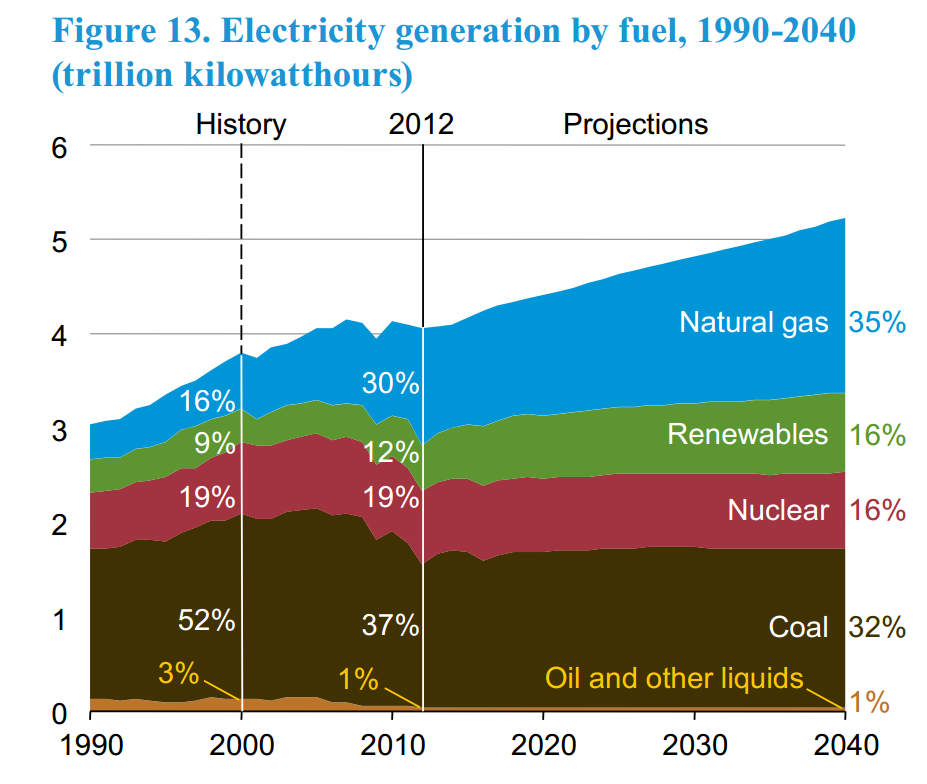
      Here is the Figure outlining the long term forecast under the AEO 2014 reference case for US grid power:


      We were surprised to see that the DOE/EIA expects renewables to gain only a further 4% share of total electricity generation and reach only 16% of the total by 2040. That suggests an average annual increase of ~0.1% of the total demand annually by all renewables.
       
      Consider that wind alone moved from 3.5% to over 4.5% of the total US electricity supply this last year according to EIA EPM data. Over 1% in one year from one technology. Solar is similarly starting to see accelerated installation rates, albeit from a lower base.
       
      Considering that coal plant construction has slowed to a crawl with a paucity of projects in a long development pipeline, nuclear plant construction is sparse, and existing coal and nuclear plants closures are accelerating, it’s hard to see how they maintain such large shares and renewables gain so little.
       
      When we look at the EIA predictions for individual non-hydro renewables it becomes clear how the low combined forecast arose. Note that none of these components or the forecasts made about them have been mentioned in any way in the discussion of the report. One has to delve deep into the interactive data browser to discover any of this.
       
      AEO 2014 forecasts for individual non-hydro renewable technologies;
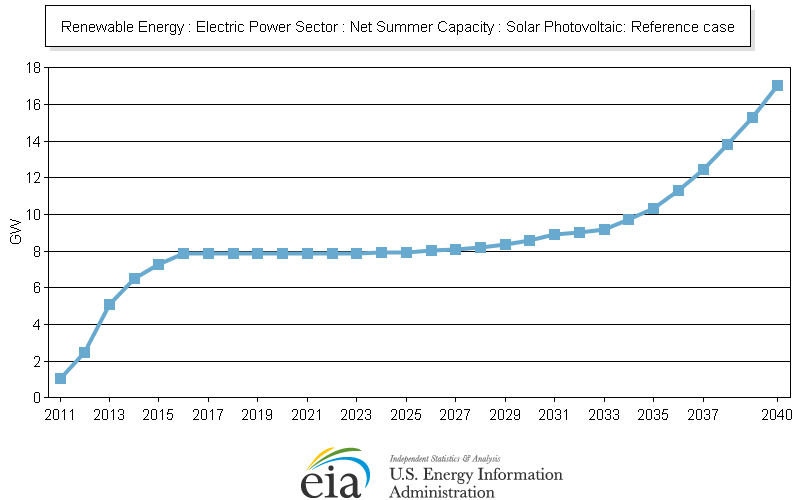
      PV Solar installations stop in 2016 and do not resume for 12 years and even then at a rate significantly below current rates.
       

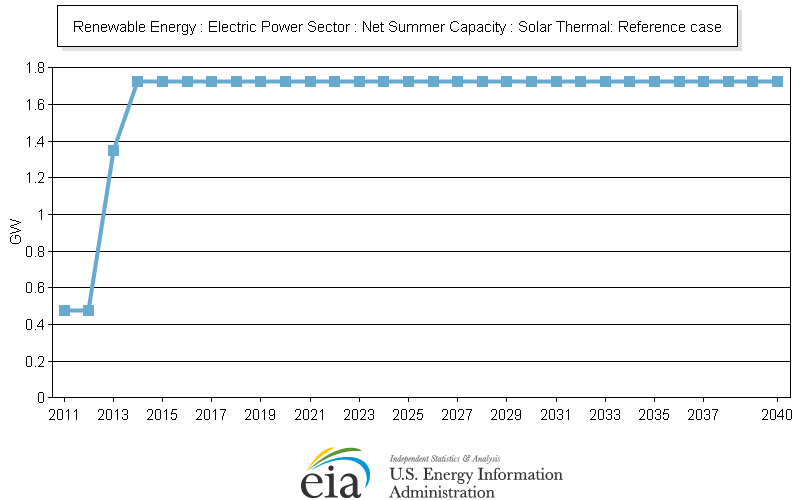
      No thermal solar is constructed past 2014.


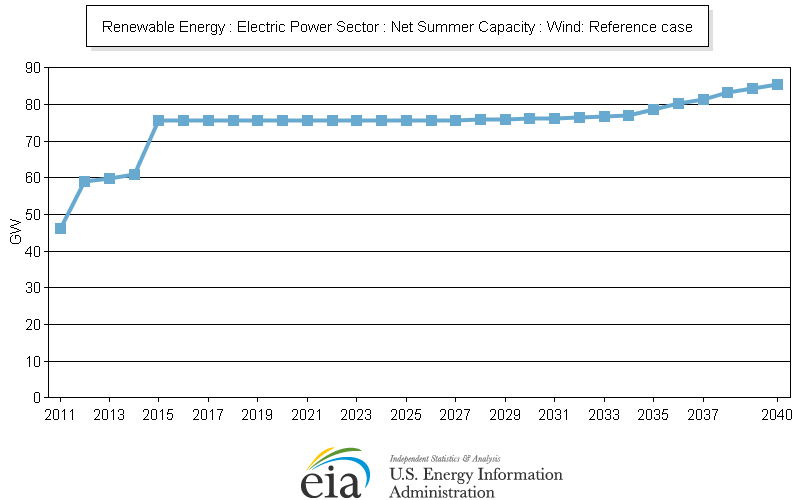
      Construction of wind farms ceases in 2016 and does not resume for almost 20 years.
       

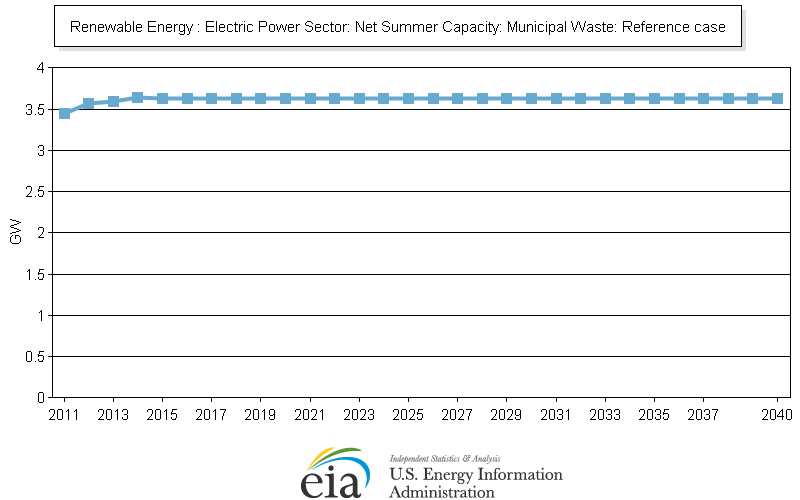
      Municipal waste generation capacity additions grind to a halt in two years, never to occur again.
       

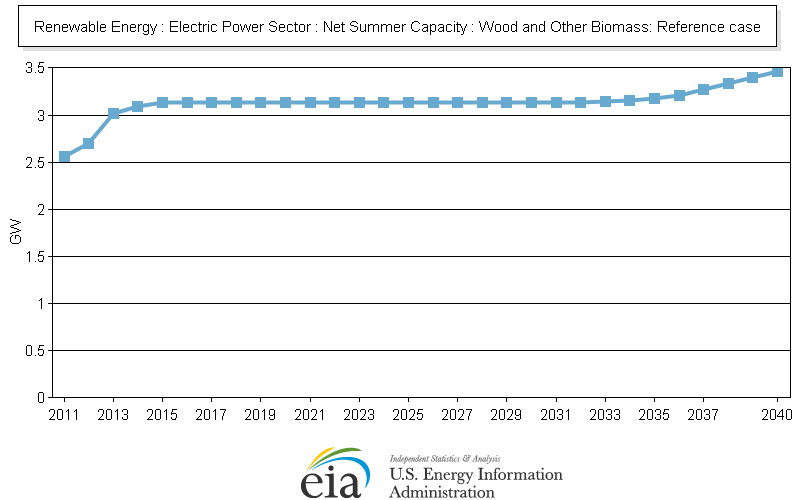
      Wood and biomass suffer a similar fate.
       
       
      We find it highly unusual that 5 statistical models using 5 data samples regarding 5 different energy technologies at varying levels of economic and technological maturity could produce such strikingly similar results. The implication is that the EIA’s official position is that all the major non-hydro grid-scale renewables will see 1-2 further years of capacity growth followed by 15-27 years of no further installations.
       
      To provide further context on one of these technologies and the forecast for its future in the report, we know from the FERC Energy Infrastructure Reports that 2.63 GW of utility-scale Solar PV has been added to the US grid in the first 11 months of 2013. The AEO 2014 would have us believe that over the next 27 years only a further 10 GW will be added, an average of only 0.37GW per year, including a 12-year hiatus from 2015 to 2027 where no solar PV whatsoever is added.
       
      Surely, if the EIA stands by these forecasts of dramatic and sudden deviations from accelerating trends in grid-scale renewable installations, they would warrant graphical publication in the report with an accompanying discussion justifying them?

      At present, they are essentially hidden, hard to find for even those with a keen interest in the subject.
      We also feel that the EIA has made thousands of forecasts in the past which never seem to be publicly visited again, for example in the 2010 AEO it was forecast that we would reach 0.45 GW of solar PV on the grid by 2035, in November 2013 we reached 7.11 GW according to the FERC.
      Surely, in making new predictions it would be appropriate for the EIA to address how their models could produce a 25 year forecast which has already been surpassed 16 times over in less than 3 years. What changes have been made to the models to improve this terrible forecasting record? If none, then should the renewable forecasts come with a disclaimer that they are highly unreliable and have a history of massive underestimation of renewable growth, surely burying them deep in the data of the report is not an appropriate strategy.
       
      Do the EIA and the DOE really stand by this report and its predictions as quality forecasts with a high probability of accurately representing future trends? We find it overwhelmingly unlikely that solar PV will soon simply stop being installed for 12 years given recent dramatic price decreases and acceleration of installations, yet the EIA report will allow a congress member to stand up and ask why the government is supporting a technology that is so uneconomical that the EIA believes it will be 12 years before any further installations will occur. We feel the other technologies we have mentioned are similarly highly pessimistically represented by this report.
       
      We ask you to review these forecasts and question whether the DOE stands by them or whether they require significant review and revision before being fit for public release as the official forecast of the DOE.
       
      Sincerely,
       
      Dennis Heidner, Bob Wallace, and RobS
       
      US solar power growth
       
       
      US wind power growth
       
       
      DOE_Solar_Deployment


      DOE_Wind_Deployment

      That doesn’t look like it’s going to flatline, does it?

      Addendum/Update following some discussion with experts on Twitter: So, what is the underlying issue with the EIA’s forecasts? The key issues are the assumptions. One of the most important assumptions is that they don’t include any changes in policy going forward. (Meaning, policies in place today remain in place until they expire… and then no new policies are added.) So, fossil fuels and nuclear keep their subsidies (which are written into the tax code and don’t expire), but renewables lose theirs within a couple of years or so and then never regain them again, and never get any policy support again. This results in pretty good base forecasts off of which other forecasts based on different policy scenarios can be built, using a variety of different policy assumptions, but it also means that no responsible person or media outlet should treat the base EIA forecast as being anything close to what will happen in reality.

      Furthermore, beyond the no-policy-change assumptions, the EIA uses a number of rather questionable cost and integration assumptions. These assumptions negatively impact the renewable energy forecasts. But that’s obviously a more complicated matter for a separate, longer discussion.
      In the end, the biggest issue seems to be this: the mass media often reports on and references these EIA forecasts as if they are actual forecasts for what will occur in the future. This results in massive misinformation spreading far and wide. Part of the blame is certainly on the mass media, but part of the blame is also on the EIA for not being very clear about this when presenting its “forecasts” and sharing them with the public and media. For example, in the executive summary of the early release of the Annual Energy Outlook 2014, it is written that the projections are made “under the assumption that current laws and regulations remain generally unchanged throughout the projection period.” That can easily be read as saying that, when the laws expire, the EIA is assuming that the laws are renewed and continue as they are set today. But it actually means that there will be no laws renewed and no new laws supporting renewable energy development will be enacted, which is completely unlikely to happen. A member of the mass media could very easily misunderstand that line… if they look at it at all. 

      And, again, there are a number of other technical assumptions that are very questionable and counter to renewables.

      The end point: don’t treat the EIA’s Annual Energy Outlook base case projections as actual, realistic projections. They are primarily useful for forecasters as building blocks for their own more realistic forecasts.

      Read more at http://cleantechnica.com/2014/01/10/horrible-eia-forecasts-letter-cleantechnica-readers/#2PuJphLy8zoygD5O.99

      Wednesday, January 8, 2014

      Hydrogen Cars Arrive in 2014


      Hyundai and Toyota have both announced that they will be introducing hydrogen fuel cell cars into the marketplace in the latter part of 2014.  In the U.S., it will begin in California, where the various car manufacturers have been testing fuel cell prototypes for years.  In the U.S., California has been a leader in clean, automotive technology. A number of hydrogen fueling stations are already in place and more are coming.   Europe has put much more effort into building infrastructure for hydrogen vehicles. Most likely, these clean running machines will gain a foothold in the European Union first, simply because European energy policy aggressively encourages  the adoption of hydrogen and other clean energy technologies.


      Toyota Fuel Cell Car


      The fossil fuel industry has long used its wealth and political influence to undermine the credibility of hydrogen as a clean energy alternative.  Despite the naysayers, hydrogen continues to emerge, because it works. It is nature's elegantly simple answer: clean, non-toxic, cost effective, and safe when properly managed.  I suspect by 2020, the transition into the hydrogen age will be well underway.

      Here is a very engaging video from Toyota showcasing their new fuel cell car... http://www.youtube.com/watch?v=z7xCbmkWKkw


      Here is a link to the website for the California Fuel Cell Partnership... http://cafcp.org/


      Saturday, January 4, 2014

      Americans Don't Trust Scientists


      Sad but true. I can't remember a time in my life when there has been more distrust of what science has to tell us. The high level of public skepticism about global climate change is amazing given that about 99% of all climate researchers say the same thing: climate change is real; it's based on well understood atmospheric chemistry; it's a problem of immense scale that must be addressed with bold policy changes, without delay.

      Why are so many people skeptical? Because hundreds of millions of dollars are being spent to undermine the credible science on climate change by the fossil fuel industry, the chief cause of the air pollution that is driving atmospheric warming.  The people behind dirty fuels like coal and oil are aggressively attempting to corrupt the science behind climate change to preserve their own economic self-interest.  Fostering skepticism is a big part of their agenda.  If you want to know where the truth lies, there is an old adage that applies: 'Follow the money'.


      __________________________


      Americans Don't Trust Scientists

      Reposted from The Huffington Post - 12-26-13

      How much faith do Americans have in scientists and science journalists? Not a whole lot, a new survey finds.

      In a new HuffPost/YouGov poll, only 36 percent of Americans reported having "a lot" of trust that information they get from scientists is accurate and reliable. Fifty-one percent said they trust that information only a little, and another 6 percent said they don't trust it at all.

      Science journalists fared even worse in the poll. Only 12 percent of respondents said they had a lot of trust in journalists to get the facts right in their stories about scientific studies. Fifty-seven percent said they have a little bit of trust, while 26 percent said they don't trust journalists at all to accurately report on scientific studies.

      What’s more, many Americans worry that the results of scientific studies are sometimes tainted by political ideology -- or by pressure from the studies’ corporate sponsors.

      A whopping 78 percent of Americans think that information reported in scientific studies is often (34 percent) or sometimes (44 percent) influenced by political ideology, compared to only 18 percent who said that happens rarely (15 percent) or never (3 percent).

      Similarly, 82 percent said that they think that scientific findings are often (43 percent) or sometimes (39 percent) influenced by the companies or organizations sponsoring them.

      Republicans in the new poll were most likely to say that they have only a little bit of trust in scientists to give accurate and reliable information, and the most likely to say that they think scientific findings may be tainted by political ideology -- possibly reflecting distrust in scientists over topics such as evolution and climate change.


      The HuffPost/YouGov poll was conducted Dec. 6-7 among 1,000 U.S. adults using a sample selected from YouGov's opt-in online panel to match the demographics and other characteristics of the adult U.S. population. Factors considered include age, race, gender, education, employment, income, marital status, number of children, voter registration, time and location of Internet access, interest in politics, religion and church attendance.

      The Huffington Post has teamed up with YouGov to conduct daily opinion polls. You can learn more about this project and take part in YouGov's nationally representative opinion polling.