Showing posts with label Thom Hartmann. Show all posts

Wednesday, December 17, 2014

America Has a White Millennial Problem


This is a very interesting and somewhat troubling picture of young adult America. I don't think the polls are presenting an accurate picture of where most of millennials are politically. I think young people want clean air, reproductive freedom of choice,  and a biosphere that is protected from brutish exploitation by mindless profiteers. 

Maybe young people aren't polling so strongly for Democrats because they recognize that the Democratic Party is part of the problem.  What they want is a progressive alternative that is forward thinking, life-affirming, and sustainable.  To get that, the corruption that is pervasive in American politics must stop.  We need a 28th Amendment that says 'Corporations are not People' and 'Money is not Speech'.  That is the way to energize millennials. Give them a worthy pathway into the future..EMPDX.

Sean McElwee wrote this piece for AlterNet. Nice work Sean...


Saturday, November 15, 2014

Top 0.1 Percent Has More Wealth Than Bottom 90 Percent


This post comes from an article on the Mother Jones  blog by Inae Oh.

It's a reflection of what is fundamentally wrong in America.  Less than 160,000 families have more money than the other 316 million of us combined.    Stunning, shameful, incredibly corrosive to our economy and our democracy:.. those are some words I would choose to describe this circumstance.

Economics is pretty simple at its most basic.  Markets are a place where sellers come to deal with people who have the need to buy at least the necessities among all those things for sale. But, when the vast majority of people are no longer able to participate in that marketplace, because they have almost nothing to exchange for even basic needs like  food, shelter, and healthcare; when that happens,  the entire idea of a marketplace is undermined.    Sad to say, that is exactly what is wrong with America's today.  In effect, our economy is trapped in a malaise caused a tiny fraction of us owning all the wealth. 

All of the political power in America has fallen into the hands of big bankers, bloated corporations, and the super-rich.  Until that changes,  nine out of ten of us will continue to get the very short end of the stick.
_________________

From Inae Oh's Mother Jones blog piece...

While a complex web of factors have contributed to the rise in income inequality in America, a new research paper says most of the blame can be largely placed in the immense growth experienced by the top tenth of the richest 1 percent of Americans in recent years. From the report:

The rise of wealth inequality is almost entirely due to the rise of the top 0.1% wealth share, from 7% in 1979 to 22% in 2012, a level almost as high as in 1929. The bottom 90% wealth share first increased up to the mid-1980s and then steadily declined. The increase in wealth concentration is due to the surge of top incomes combined with an increase in saving rate inequality.
So, who are the 0.1 percent among us? According to Emmanuel Saez and Gabriel Zucman, the paper's researchers, the elite group is a small one, roughly composed of 160,000 families with assets exceeding $20 million, but their grip on America's wealth distribution is about to surpass the bottom 90 percent for the first time in more than half a century.  Today's 0.1 percent also tend to be younger than the top incomers of the 1960's, despite the fact the country as a whole has been living longer—proving once again, that there has truly never been a more opportune time to be rich in America:


Saturday, November 1, 2014

Green World Rising


A new video produced by Leo DeCaprio and Thom Hartmann shows that with existing technology, our global human society can be completely free of our dependence on coal, oil, and natural gas in about two decades.

Clean, renewable sources of energy from wind, solar, geothermal, and hydro power derived from ocean tidal forces and river currents can provide all the power the world needs without generating any atmospheric pollution.  This new video, narrated by Leo DeCaprio presents that clean energy future very effectively. 

The impediments to this kind of life-affirming future are not technical. We can do it with technology that is already developed.  The obstacle to this kind of future is entirely political, driven by corporatists and elites who profit from the status quo and are unwilling to accept any change that threatens their income.

Bottom line: A clean energy future is imminently achievable, if the people demand it.

Here is a link to Green World Rising... http://www.greenworldrising.org/#!ep3-green-world-rising/ches


Monday, July 14, 2014

The U.S. Supreme Court - A Corporation's Best Friend


There is nothing written in law that gives corporations human rights, but that hasn't stopped the Supreme Court. Over the years, conservative majority's on the court have issued ten decisions that have bolstered corporate personhood, and seriously undermined the rights of the nation's human citizens in the process.

I pulled the article below from Mother Jones.
 ____________________________

10 Supreme Court Rulings—Before Hobby Lobby—That Turned Corporations Into People

Last week's decision is the latest in a 200-year-long line of rulings giving businesses the same rights as humans.

Wednesday, April 2, 2014

McCutcheon Vs. FEC


Well, today the Supreme Court did it again. It ruled there should be no limits on campaign spending in our elections.   The floodgates have now opened for billionaires like the Koch Brothers to own America's political system.  It was bad enough when the slug bait conservatives on the court voted 5-4 for Citizen's United, the first step on the road to 'he who has the money makes the rules'. 

McCutcheon Vs. FEC effectively removes all remaining limits to the amount of money a corporation or an individual can spend to influence our elections.   We no longer have a democracy.  We have an oligarchy controlled by super-rich plutocrats.

The sad thing is most Americans still seem to be in the dark about this.  Just last week, a poll revealed that 52% of Americans don't know who the Koch Brothers are.   That is very disturbing, given the fact that the Koch's, who inherited their wealth from their father,  are the poster boys for egregious spending to buy the politics they want.

Though corporate conservatives, most of whom are Republican, are primarily responsible for the sewer money politics that prevail in this country, both parties are guilty of feeding on dirty money from the Koch's and other super rich political manipulators.

There is only one answer that will restore our Constitution. That is a 28th Constitutional Amendment that says specifically that Corporations are not people and money is not speech.  The people we elect to govern our country will not make this happen. They are part of the problem.  To make this right, the American people must step up and stand together in a grass root effort to rid our politics of big money influence.

There is a group called Move to Amend. It's one and only focus is on a Constitutional Amendment that says corporations are not people and money is not speech.  I support Move to Amend.  Every American has a duty to stand together to support Move to Amend's unambiguous and straightforward Constitutional remedy.

The Constitution is supposed to serve the interests of all the people, not just the rich and powerful.  If you aren't already onboard,  take the time to learn about Move to Amend, then join us and become part of the solution. We all have a stake in this fight.  It's time to step up and be counted.

Visit the Move to Amend website...www.movetomend.org


Saturday, February 1, 2014

The Crash of 2016


Thom Hartmann's new book, The Crash of 2016 offers evidence and historical context for yet another economic collapse of our society. What happened in 2008 is about to happen again, only this time, it will be much worse.  That's the unambiguous conclusion of The Crash of 2016.  


I have read many of Hartmann's books. His worldview is built on solid research. In a nutshell, as he sees it, human civilization is on the precipice. Too many people, too few resources, and a  political system that is corrupt to the core.  What Hartmann calls Economic royalists have brought America to its knees before. In fact, there's a pattern. Hartmann's calls it the great forgetting, where every fourth generation removed from an economic meltdown caused by the hubris of corporations, banksters, and individuals exercising unrestrained self-interest, it happens again. In 1929, the world fell into a great depression, driven largely by the excessive gaming of the economic system by the rich.  In response, the people elected Franklin Roosevelt. As President, he launched a recovery with his progressive 'New Deal' ideas. Then World War Two came. In it's aftermath, America and the rest of the world moved into an extended period of economic growth and broadly realized prosperity.  Then, in 1980, Ronald Reagan was elected President. He and his neo-conservative cabal cut taxes on the rich and launched an era of deregulation that set us on an inevitable course for another collapse.  The American middle class has been eviscerated by conservative, 'supply-side' economic policy.  The first reckoning came with the 2008 economic meltdown. Unfortunately, the response was entirely inadequate. The neo-conservatives who caused the meltdown were not held accountable.  Because of inadequate policy reforms, the recovery from 2008 has been tepid at best.   Now, as Thom Hartmann so effectively points out, we are headed toward another collapse. This one will be much more severe than what happened in 2008.  Hartmann makes a very strong case for another economic breakdown in 2016, give or take a year or two.

So, what do we do?  First, we brace for what appears to be inevitable; another collapse of our economic system.  As before, there will be a lot of finger pointing. The neo-conservatives will blame everyone but themselves. We will have a choice.  We can stay the course and allow corporations, the banksters, and the rich to run roughshod over what's left of our civilization, or we can elect leaders who will choose a progressive course and make much-needed reforms to our system of governance...reforms that will restore 'of, by, and for the people' to our way of life.

Thom Hartmann's The Crash of 2016 delivers  a clear prescription for what we as citizens must do to rebuild from the ashes of the crash that's coming. His vision offers hope for a new order that is both life-affirming and sustainable over the long term.

Highest recommendation.


Here is a link to Thom Hartmann's website and radio show...  http://www.thomhartmann.com/


Tuesday, October 29, 2013

Top 10 Policies for a Steady-State Economy


Anybody who is paying attention knows that the economic engine that makes the global economy go has gone off the tracks.    It's too many people and too few resources, combined with the corrosive impact of the current predatory brand of market capitalism.  We live in a world where the super-rich and giant corporations use their money and influence to put their own interests first. The current market economic model serves the few at the expense of the many. We are squandering the planet's limited natural resources.  Our operating system needs a serious upgrade to one in which the needs of people - all people - are in balance with the planet's ability to provide.

Economist Herman Daly has long been a beacon for a steady-state economy, which is exactly what is required to balance a broadly realized quality of life for humanity with the enduring needs of our earth's natural systems. The article below by Herman Daly offers a clear prescription for reshaping our regulatory framework to foster a steady-state way of life.  It's not complicated. A number of European nations are already on this life affirming road. Norway, Denmark, and Sweden are prime examples.  

The impediments to achieving a steady-state paradigm  are entirely political.  Our current system is mired in corruption. The first step to a life-affirming, steady-state economy is a Constitutional Amendment that declares that corporations are not people, and that  'Personhood' is s status given only to 'flesh and blood' humans. Further, this amendment must declare that money is not the same as speech.  Blunting these two morally bankrupt legal constructs will go a long way toward restoring 'of, by, and for' the people to our democracy.

The good news is a group called Move to Amend is aggressively promoting just such a Constitutional change.

 I urge the visitor to read the article pasted in below. If you want to encourage a world that works for future generations, Herman Daly's 'Top Ten Policies' are a very good place to start.

_________________________________


Top 10 Policies for a Steady-State Economy

Posted By Herman Daly On October 28, 2013 @ 9:00 pm In Economic Growth,Economic Policy,Environment,Herman Daly,Jobs and Employment,Money and Investments,Population,Poverty Alleviation,Steady State Economy,Sustainability | 2 Comments

by Herman Daly


Let’s get specific. Here are ten policies for ending uneconomic growth [1] and moving to a steady-state economy. A steady-state economy is one that develops qualitatively (by improvement in science, technology, and ethics) without growing quantitatively in physical dimensions; it lives on a diet — a constant metabolic flow of resources from depletion to pollution (the entropic throughput) maintained at a level that is both sufficient for a good life and within the assimilative and regenerative capacities of the containing ecosystem.

Ten is an arbitrary number — just a way to get specific and challenge others to suggest improvements. Although the whole package here discussed fits together in the sense that some policies supplement and balance others, most of them could be adopted singly and gradually.

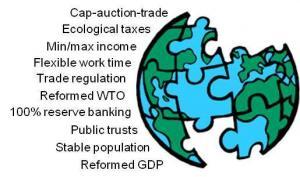
1. Cap-auction-trade systems for basic resources. Caps limit biophysical scale by quotas on depletion or pollution, whichever is more limiting. Auctioning the quotas captures scarcity rents for equitable redistribution. Trade allows efficient allocation to highest uses. This policy has the advantage of transparency. There is a limit to the amount and rate of depletion and pollution that the economy can be allowed to impose on the ecosystem. Caps are physical quotas, limits to the throughput of basic resources, especially fossil fuels. The quota usually should be applied at the input end because depletion is more spatially concentrated than pollution and hence easier to monitor. Also the higher price of basic resources will induce their more economical use at each upstream stage of production, as well as at the final stages of consumption and recycling. Ownership of the quotas is initially public — the government periodically auctions them to individuals and firms. There should be no “grandfathering” of quota rights to previous users, nor “offshoring” of quotas for new fossil fuel power plants in one by place by credits from planting trees somewhere else. Reforestation is a good policy on its own.  It is too late for self-canceling half measures — increased carbon sequestration and decreased emissions are both needed. The auction revenues go to the treasury and are used to replace regressive taxes, such as the payroll tax, and to reduce income tax on the lowest incomes. Once purchased at auction the quotas can be freely bought and sold by third parties, just as can the resources whose rate of depletion they limit. The cap serves the goal of sustainable scale; the auction serves the goal of fair distribution; and trading allows efficient allocation — three goals, three policy instruments. Although mainly applied to nonrenewable resources, the same logic works for limiting the off-take from renewable resources, such as fisheries and forests, with the quota level set to approximate a sustainable yield.


2. Ecological tax reform. Shift the tax base from value added (labor and capital) to “that to which value is added,” namely the entropic throughput of resources extracted from nature (depletion), and returned to nature (pollution). Such a tax shift prices the scarce but previously un-priced contribution of nature. Value added to natural resources by labor and capital is something we want to encourage, so stop taxing it. Depletion and pollution are things we want to discourage, so tax them. Payment above necessary supply price is rent, unearned income, and most economists have long advocated taxing it, both for efficiency and equity reasons. Ecological tax reform can be an alternative or a supplement to cap-auction-trade systems.


3. Limit the range of inequality in income distribution with a minimum income and a maximum income. Without aggregate growth poverty reduction requires redistribution. Unlimited inequality is unfair; complete equality is also unfair. Seek fair limits to the range of inequality. The civil service, the military, and the university manage with a range of inequality of a factor of 15 or 20. Corporate America has a range of 500 or more. Many industrial nations are below 25. Could we not limit the range to, say, 100, and see how it works? This might mean a minimum of 20 thousand dollars and a maximum of two million. Is that not more than enough to give incentive for hard work and compensate real differences? People who have reached the limit could either work for nothing at the margin if they enjoy their work, or devote their extra time to hobbies or public service. The demand left unmet by those at the top will be filled by those who are below the maximum. A sense of community, necessary for democracy, is hard to maintain across the vast income differences current in the United States. Rich and poor separated by a factor of 500 have few experiences or interests in common, and are increasingly likely to engage in violent conflict.


4. Free up the length of the working day, week, and year — allow greater option for part-time or personal work. Full-time external employment for all is hard to provide without growth. Other industrial countries have much longer vacations and maternity leaves than the United States. For the classical economists the length of the working day was a key variable by which the worker (self-employed yeoman or artisan) balanced the marginal disutility of labor with the marginal utility of income and of leisure so as to maximize enjoyment of life. Under industrialism the length of the working day became a parameter rather than a variable (and for Karl Marx was the key determinant of the rate of exploitation). We need to make it more of a variable subject to choice by the worker. Milton Friedman wanted “freedom to choose” — OK, here is an important choice most of us are not allowed to make! And we should stop biasing the labor-leisure choice by advertising to stimulate more consumption and more labor to pay for it. At a minimum advertising should no longer be treated as a tax-deductible expense of production.

5. Re-regulate international commerce — move away from free trade, free capital mobility, and globalization. Cap-auction-trade, ecological tax reform, and other national measures that internalize environmental costs will raise prices and put us at a competitive disadvantage in international trade with countries that do not internalize costs. We should adopt compensating tariffs to protect, not inefficient firms, but efficient national policies of cost internalization from standards-lowering competition with foreign firms that are not required to pay the social and environmental costs they inflict. This “new protectionism” is very different from the “old protectionism” that was designed to protect a truly inefficient domestic firm from a more efficient foreign firm. The first rule of efficiency is “count all the costs” — not “free trade,” which coupled with free capital mobility leads to a standards-lowering competition to count as few costs as possible. Tariffs are also a good source of public revenue. This will run afoul of the World Trade Organization/World Bank/International Monetary Fund, so….


Ten pieces of the policy puzzle for an earth-centric economy
 
Ten pieces of the policy puzzle for an earth-centric economy
 
 
6. Downgrade the WTO/WB/IMF. Reform these organizations based on something like Keynes’s original plan for a multilateral payments clearing union, charging penalty rates on surplus as well as deficit balances with the union — seek balance on current account, and thereby avoid large foreign debts and capital account transfers. For example, under Keynes’s plan the U.S. would pay a penalty charge to the clearing union for its large deficit with the rest of the world, and China would also pay a similar penalty for its surplus. Both sides of the imbalance would be pressured to balance their current accounts by financial penalties, and if need be by exchange rate adjustments relative to the clearing account unit, called the “bancor” by Keynes. The bancor would also serve as the world reserve currency, a privilege that should not be enjoyed by any national currency, including the U.S. dollar. Reserve currency status for the dollar is a benefit to the U.S. — rather like a truckload of free heroin is a benefit to an addict. The bancor would be like gold under the gold standard, only you would not have to tear up the earth to dig it out. Alternatively a regime of freely fluctuating exchange rates is a viable possibility requiring less international cooperation.


7. Move away from fractional reserve banking toward a system of 100% reserve requirements. This would put control of the money supply and seigniorage (profit made by the issuer of fiat money) in the hands of the government rather than private banks, which would no longer be able to live the alchemist’s dream by creating money out of nothing and lending it at interest. All quasi-bank financial institutions should be brought under this rule, regulated as commercial banks subject to 100% reserve requirements. Banks would earn their profit by financial intermediation only, lending savers’ money for them (charging a loan rate higher than the rate paid to savings or “time-account” depositors) and charging for checking, safekeeping, and other services. With 100% reserves every dollar loaned to a borrower would be a dollar previously saved by a depositor (and not available to him during the period of the loan), thereby re-establishing the classical balance between abstinence and investment. With credit limited by prior saving (abstinence from consumption) there will be less lending and borrowing and it will be done more carefully — no more easy credit to finance the massive purchase of “assets” that are nothing but bets on dodgy debts. To make up for the decline in bank-created, interest-bearing money the government can pay some of its expenses by issuing more non-interest-bearing fiat money. However, it can only do this up to a strict limit imposed by inflation. If the government issues more money than the public voluntarily wants to hold, the public will trade it for goods, driving the price level up. As soon as the price index begins to rise the government must print less and tax more. Thus a policy of maintaining a constant price index would govern the internal value of the dollar. The Treasury would replace the Fed, and the target policy variables would be the money supply and the price index, not the interest rate. The external value of the dollar could be left to freely fluctuating exchange rates (or preferably to the rate against the bancor in Keynes’s clearing union).


8. Stop treating the scarce as if it were free, and the free as if it were scarce. Enclose the remaining open-access commons of rival natural capital (e.g., the atmosphere, the electromagnetic spectrum, and public lands) in public trusts, and price them by cap-auction-trade systems, or by taxes.  At the same time, free from private enclosure and prices the non-rival commonwealth of knowledge and information. Knowledge, unlike the resource throughput, is not divided in the sharing, but multiplied. Once knowledge exists, the opportunity cost of sharing it is zero, and its allocative price should be zero. International development aid should more and more take the form of freely and actively shared knowledge, along with small grants, and less and less the form of large interest-bearing loans. Sharing knowledge costs little, does not create un-repayable debts, and increases the productivity of the truly rival and scarce factors of production. Patent monopolies (aka “intellectual property rights”) should be given for fewer “inventions,” and for fewer years. Costs of production of new knowledge should, more and more, be publicly financed and then the knowledge freely shared. Knowledge is a cumulative social product, and we have the discovery of the laws of thermodynamics, the double helix, polio vaccine, etc. without patent monopolies and royalties.


9. Stabilize population. Work toward a balance in which births plus in-migrants equals deaths plus out-migrants. This is controversial and difficult, but as a start contraception should be made available for voluntary use everywhere. And while each nation can debate whether it should accept many or few immigrants, and who should get priority, such a debate is rendered moot if immigration laws are not enforced. We should support voluntary family planning and enforcement of reasonable immigration laws, democratically enacted.


10. Reform national accounts — separate GDP into a cost account and a benefits account. Natural capital consumption and “regrettably necessary defensive expenditures” belong in the cost account. Compare costs and benefits of a growing throughput at the margin, and stop throughput growth when marginal costs equal marginal benefits. In addition to this objective approach, recognize the importance of the subjective studies that show that, beyond a threshold, further GDP growth does not increase self-evaluated happiness. Beyond a level already reached in many countries, GDP growth delivers no more happiness, but continues to generate depletion and pollution. At a minimum we must not just assume that GDP growth is economic growth, but prove that it is not uneconomic growth.

Currently these policies are beyond the pale politically. To the reader who has persevered this far, I thank you for your willing suspension of political disbelief. Only after a significant crash, a painful empirical demonstration of the failure of the growth economy, would this ten-fold program, or anything like it, stand a chance of being enacted.

To be sure, the conceptual change in vision from the norm of a growth economy to that of a steady-state economy is radical. Some of these proposals are rather technical and require more explanation and study. There is no escape from studying economics, even if, as Joan Robinson said, the main reason for it is to avoid being deceived by economists. Nevertheless, the policies required are far from revolutionary, and are subject to gradual application. For example, 100% reserve banking was advocated in the 1930s by the conservative Chicago School and can be approached gradually, the range of distributive inequality can be restricted gradually, caps can be adjusted gradually, etc. More importantly, these measures are based on the impeccably conservative institutions of private property and decentralized market allocation. The policies here advocated simply reaffirm forgotten pillars of those institutions, namely that: (1) private property loses its legitimacy if too unequally distributed; (2) markets lose their legitimacy if prices do not tell the truth about opportunity costs; and as we have more recently learned (3) the macro-economy becomes an absurdity if its scale is required to grow beyond the biophysical limits of the Earth.


Herman Daly
Herman Daly
 
 
Well before reaching that radical biophysical limit, we are encountering the classical economic limit in which extra costs of growth become greater than the extra benefits, ushering in the era of uneconomic growth, whose very possibility is denied by the growthists. The inequality of wealth distribution has canceled out the traditional virtues of private property by bestowing nearly all benefits of growth to the top 1%, while generously sharing the costs of growth with the poor. Gross inequality, plus monopolies, subsidies, tax loopholes, false accounting, cost-externalizing globalization, and financial fraud have made market prices nearly meaningless as measures of opportunity cost. For example, a policy of near zero interest rates (quantitative easing) to push growth and bail out big banks has eliminated the interest rate as a measure of the opportunity cost of capital, thereby crippling the efficiency of investment. Trying to maintain the present growth-based Ponzi system is far more unrealistic than moving to a steady-state economy by something like the policies here outlined. It is probably too late to avoid unrealism’s inevitable consequences. But while we are hunkered down and unemployed, enduring the crash, we might think about the principles that should guide reconstruction.


Article printed from Center for the Advancement of the Steady State Economy: http://steadystate.org

Wednesday, October 2, 2013

Threshold: The Crisis of Western Culture


I have been a fan of Thom Hartmann for close to two decades. He writes about what is wrong with America and what needs to happen to make it right. He does it eloquently, persuasively, courageously.

I just finished Threshold, the fifth book I've read by Hartmann.  I admire the man tremendously. 


Many well-meaning  people are toiling in the trenches to make a difference on a broad range of global scale challenges. Though many of these issues are unprecedented, climate change being just one example, they are really symptoms of a broken human culture, largely disconnected from the  natural world. Thom Hartmann cuts to the core. He focuses on  the bloated brand of legalized bribery that has perverted our political system. He makes the case that our system of governance has been hijacked by multi-national corporations  and the super rich,  who use their wealth and undue influence to shape public policy for their own narrow interests.   Corporate conservatives employ two morally bankrupt legal constructs to get away with their pathological behavior...

1. Money is treated as a form of speech under U.S. law, which allows the rich and powerful to use their wealth to pervert our political process.  

2. Corporations are considered 'persons' under the law,  giving them 'rights' that should be reserved for human citizens.

In Threshold, Thom Hartmann offers a thoughtful curative prescription for restoring democracy to America; a genuine democracy built on a foundation of compassion, inclusiveness, reconnection with nature, and  governance that is accountable to all citizens rather than a privileged few.

Five stars for Threshold.  Another powerful, enlightening, life affirming book by an author whose work illuminates a pathway to a sustainable future worthy of our best human instincts.


Thom Hartmann is the progressive radio antidote to the bilge spouted daily by right-wing radio icon, Rush Limbaugh. 

Thom Hartmann's weekday radio talk show can be heard at his website...  http://www.thomhartmann.com/tv/watch


Monday, February 11, 2013

We The People Amendment


Today, in Washington, D.C., a bill to amend the Constitution is being introduced in Congress. It's focus is to eliminate corporate personhood and also to declare that 'money' is not speech.   In all the world, there is no legislative effort more important than this.  Every important issue we face, every challenge we must deal with is affected profoundly by the corrosive and corruptive influence of dirty money in the political process.


There is so much that is broken about our economy, our culture, our system of governance.  A large share of the dysfunction can be traced to ethically vacuous, corporate lobbyists, heavily armed with influence money.   

Wall Street controls and corrupts the nation's financial landscape with it's money. Big oil controls the energy agenda and blocks any meaningful action on climate change. The timber industry shapes the rules on forests. Big Pharma and the health insurance industry get their way with fat campaign contributions to their elected minions in the house and senate.  

Where public policy is involved, legalized bribery is what we have in America. He who has the money makes the rules. Until that is no longer true, nothing will really change. No matter your particular issue, genuine corrective action will not come until we get rid of the two morally bankrupt legal constructs that allow corporations and the rich to make the rules.

Corporations are not people, but the law treats them as such. Money is not speech, but the courts say it is.  As long as this is true, there is little hope for meaningful action on the critical issues we face as a society.

There are a number of efforts underway to deal with corporate personhood and money as speech. What is required is a constitutional amendment.  The group, Move to Amend, is focused like a laser on delivering just that - a constitutional amendment that will abolish corporate personhood and money as speech.  Today, February 11th is a big day. It's the launch of a first effort to push through an amendment. It won't be easy. In fact, it will be very challenging to pull off.  We all need to get on board with this and stay with it for the long haul. Eliminating the improper influence of corporations and the rich must become  a goal every American citizen embraces with enthusiasm and resolve.

Here is a link to the webpage for the 'We The People' Amendment. https://movetoamend.org/wethepeopleamendment


Saturday, December 1, 2012

America the Possible

James Gustave Speth is the former Dean of the Yale University School of Forestry.  He was a founder of the National Resources Defense Council. He's written a number of books, the most recent of which is, America the Possible: Manifesto for a New Economy

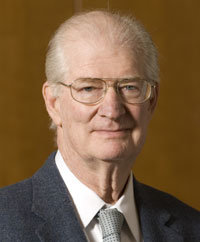
James Gustave Speth


I had high hopes when I began reading America the Possible. When an author uses the word 'manifesto' in the title of a book, one  expects it to offer a specific prescription; a remedy for what ails that can be embraced by the masses. In a word, Dr. Speth's new book is terrific. It's an effecive and most worthy effort  from a genuinely good soul, who certainly qualifies as one of the world's most distinguished voices for the environment.


The arguments in this book are presented succinctly and with great aplomb. Speth begins with a review of  the social, economic, political, and environmental consequences of our government's current status as a wholly owned subsidiary of giant corporations and the super wealthy.  In effect, argues Speth, the American people have allowed the jackals to take charge of Uncle Sam's henhouse. 

On a  global scale,the evidence is clear. All of the human culture is in a tailspin.  Speth calls for a democratic transformation of the institutions society depends on. Public policy and governance must be reinvented to moderate and manage the destructive forces at work in the modern world.  This effort must be driven from the bottom up by citizens galvanized into a political force that can stand up to the daunting influence of the rich and powerful.

America the Possible is a very important book. Speth paints from a global perspective, but focuses mainly on the United States. It's all too clear that we Americans are a big part of the problem.

Speth covers a lot of bases.  He urges the nurturing and participation in a national scale, even global scale movement.  It turns out, the organized grass roots are already deep. Paul Hawken's book, Blessed Unrest reports on the hundreds of millions of people who are engaged in grassroots progressivism around the world. An extraordinary amount of human potential; the problem at the moment is all that human energy is unfocused.  Imagine what might be possible if you could get all those people on the same page.

That's where I think America the Possible comes up a tad short.  If it's me trying to galvanize the grassroots, I would put the focus on something that will inspire Americans who want to see the restoration of our nation's core democratic princples.  I'm talking about a goal, a rallying cause that can power the evolution to a human civilization that every person would or should wish for. It has to be something that will get grassroots social, political, economic, and environmental leaders all together on a single formidible task.

Leaders are not generally good at being followers. There are many single issues that ignite passion among the tens of thousands of leaders who fall under the progressive umbrella. The leaders of those single issue groups must be mobilized to an unprecidented degree. They must choose to channel a significant portion of their energy toward a great shared goal.  

Restoring genuine representative democracy to America is a very tall order.   If I were responsible for instilling inspiration, I would focus on two morally bankrupt legal constructs as a rallying point for progressives.  One is the treatment of corporations as persons under the law. The other is money being protected as a form of speech.  These two ideas allow the rich and powerful to own public policy and the process of governance in America. Neither concept has ever passed muster in the legislative process. Neither has ever been signed into law. In both instances [Santa Clara County vs Southern Pacific in 1886, Buckley vs. Valeo in 1976], it was overreaching by conservative Supreme Courts that provided legal standing. 

More recently, the current conservative dominated Supreme Court doubled down with a ruling called, Citizens United.  Because of this ruling, corporations and the rich are allowed to flood the American elective process with limitless amounts of campaign cash anonymously.  Hundreds of millions were invested by corporations and the rich into influencing the 2012 election, almost entirely to support conservative candidates and initiatives.   In essence, these two repugnant ideas provide the framework for a deeply entrenched political brand of legalized bribery.  We are where we are at the moment in America because rich and powerful corporations and individuals are unaccountible for the massive, undemocratic influence they wield over public policy and governance.

There are a number of very worthy efforts underway to push back against corporate personhood, money as speech, and the stench of  Citizens United.  I hope the smart and dedicated leaders of these groups will soon come together and pool their energy rather than competing with eachother. Before I go further, in the interest of full disclosure, I need to say that I came to embrace this particular focus after reading Thom Hartmann's book, Unequal Protection.  Hartmann urges his followers to give their attention to a group called Move to Amend.  This group is focused entirely on pushing a constitutional amendment that would eliminate corporate personhood and money being treated as speech.   I also urge support for Move to Amend.


The leaders of every progressive advocacy group, every trade union, every organization that prizes the restoration of genuine representative democracy in Amerca should rally around Move to Amend.  While we're at it,  let's demand that all political candidates seeking local, regional, state, and national elective office take a public position on corporate personhood and money as speech. 

Focusing on corporate personhood and money as speech does two things. First, it offers a real chance to actually change the law on those issues. Second, the process of getting everyone on the same page would create a single movement rallying point of amazing scale.   Such a movement would make James Gustave Speth's bold and life-affirming vision for America the Possible, not just possible, but maybe even genuinely probable.

Here is a video of James Gustave Speth talking about building a new economy
http://vimeo.com/47118890

Here is a link to a video of Thom Hartmann talking about corporate personhood... http://www.youtube.com/watch?v=Hziy7WR9TQc